
Mental Health

The Neurosciences of Health Communication: An fNIRS Analysis of Prefrontal Cortex and Porn Consumption in Young Women for the Development of Prevention Health Programs.
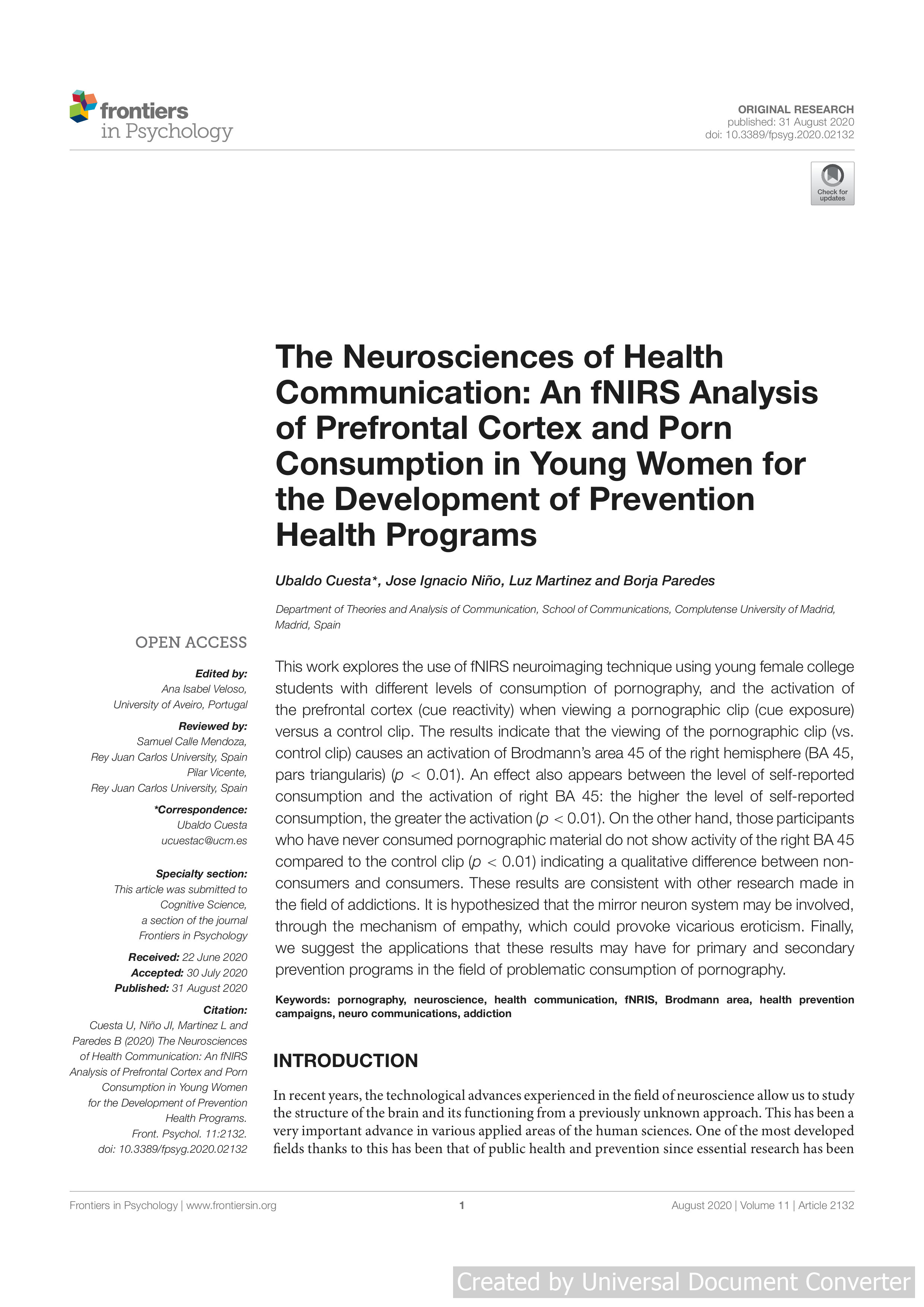 Full Article Name: The Neurosciences of Health Communication: An fNIRS Analysis of Prefrontal Cortex and Porn Consumption in Young Women for the Development of Prevention Health Programs
Open Access: Yes
Abstract
Relevance
“Thanks to neuroscience, it has been possible to investigate the reasons why adolescents are more likely to develop substance use disorders than adults….[because] during adolescence the reward/motivation mechanisms and the limbicemotional circuits exhibit a state of hyperactivity that fosters greater emotional reactivity and drives the search for behaviors that generate immediate reward. Furthermore, the prefrontal cortex cannot fully self-regulate, leading to increased impulsivity and risk taking.”
“It has been proposed that the addiction cycle is articulated in three stages and involves three fundamental brain regions: (1) the anticipatory response, mainly caused by stimuli (internal or external) involving the prefrontal cortex and which is responsible of craving, the irrepressible impulse that starts the behavior, (2) the execution of the behavior (with or without substance intake) that involves the base ganglia and the reward circuit, and (3) the extended circuit of the amygdala responsible for withdrawal and restoring balance to the stress response.”
This study found that when young women who consume pornography are exposed to porn, there was “greater cortical activity in Brodmann’s area 45 (right BA45, pars triangularis) of the right hemisphere.” This did not occur with non-consuming women.
Citation
Cuesta, U., Niño JI, Martinez, L., & Paredes, B. (2020). The neurosciences of health communication: An fnirs analysis of prefrontal cortex and porn consumption in young women for the development of prevention health programs. Frontiers in Psychology, 11, 2132–2132. https://doi.org/10.3389/fpsyg.2020.02132