
Sexuality Education & Therapy with Children

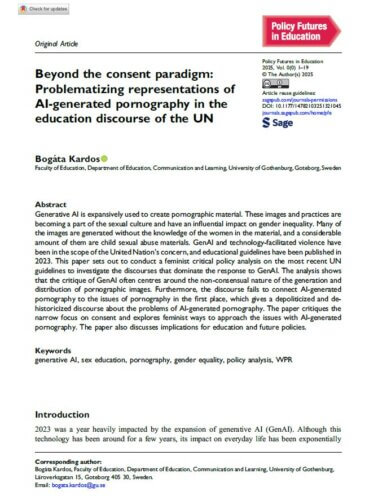
Beyond the consent paradigm: Problematizing representations of AI-generated pornography in the education discourse of the UN
Open Access: Yes.
Abstract
Generative AI is expansively used to create pornographic material. These images and practices are becoming a part of the sexual culture and have an influential impact on gender inequality. Many of the images are generated without the knowledge of the women in the material, and a considerable amount of them are child sexual abuse materials. GenAI and technology-facilitated violence have been in the scope of the United Nation’s concern, and educational guidelines have been published in 2023. This paper sets out to conduct a feminist critical policy analysis on the most recent UN guidelines to investigate the discourses that dominate the response to GenAI. The analysis shows that the critique of GenAI often centres around the non-consensual nature of the generation and distribution of pornographic images. Furthermore, the discourse fails to connect AI-generated pornography to the issues of pornography in the first place, which gives a depoliticized and dehistoricized discourse about the problems of AI-generated pornography. The paper critiques the narrow focus on consent and explores feminist ways to approach the issues with AI-generated pornography. The paper also discusses implications for education and future policies.
Relevance
“I argue that for a discourse that is striving for gender equality and the eradication of VAW [violence against women], the harms of AI-generated porn must be connected to the harms of pornography in the first place…Different paradigms, and especially the sex industry, have tried normalizing and relativizing the harms of pornography to women and men, and the leading argument is built on the consent of the women in the industry. This analysis shows that the consent paradigm fails when it comes to AI-generated pornography, and it will not be sufficient to tackle TFGBV [technology-facilitated gender-based violence]. The UN, as a major human rights agency that actively promotes gender equality, should take up the issues with pornography explicitly. AI-generated pornography should also be declared as image-based sexual abuse. The UN should also actively problematize the role of GenAI [Generative AI] in the proliferation of CSAM [child sexual abuse materials].”
Additionally, comprehensive sexuality education (CSE) “programs should foster a critical view of pornography.”
Citation
Kardos, B. (2025). Beyond the consent paradigm: Problematizing representations of AI-generated pornography in the education discourse of the UN. Policy Futures in Education, 23(5), 1021-1039. https://doi.org/10.1177/14782103251321045