Sexuality Education & Therapy with Children

Child Advocacy Workers’ Accounts of the Connections Between Pornography and Child Sexual Abuse.
Open Access: Yes.
Abstract
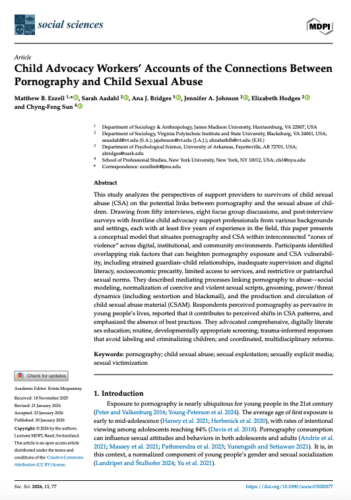
This study analyzes the perspectives of support providers to survivors of child sexual abuse (CSA) on the potential links between pornography and the sexual abuse of children. Drawing from fifty interviews, eight focus group discussions, and post-interview surveys with frontline child advocacy support professionals from various backgrounds and settings, each with at least five years of experience in the field, this paper presents a conceptual model that situates pornography and CSA within interconnected “zones of violence” across digital, institutional, and community environments. Participants identified overlapping risk factors that can heighten pornography exposure and CSA vulnerability, including strained guardian–child relationships, inadequate supervision and digital literacy, socioeconomic precarity, limited access to services, and restrictive or patriarchal sexual norms. They described mediating processes linking pornography to abuse—social modeling, normalization of coercive and violent sexual scripts, grooming, power/threat dynamics (including sextortion and blackmail), and the production and circulation of child sexual abuse material (CSAM). Respondents perceived pornography as pervasive in young people’s lives, reported that it contributes to perceived shifts in CSA patterns, and emphasized the absence of best practices. They advocated comprehensive, digitally literate sex education; routine, developmentally appropriate screening; trauma-informed responses that avoid labeling and criminalizing children; and coordinated, multidisciplinary reforms.
Relevance
“Despite their diverse professional roles, gender identities, nationalities, regional settings, racial identities, religious beliefs, and personal views on pornography, all 50 respondents recognized a clear interconnection between pornography and CSA [childhood sexual abuse].”
Risk factors of childhood exposure to pornography and child sexual abuse include “children’s un- or under-restricted access to the internet via devices such as gaming consoles, tablets, and smartphones, often without guardians’ awareness,” and “lack of education about online behavior, pornography, and child sexual exploitation,” “gender inequality and patriarchal narratives surrounding sex.”
“Sexually explicit media can significantly influence learning and imitation, especially for children who are exposed at an early age,” who then may act out what they see by engaging in sexual acts with other children.
“Many participants observed that adult perpetrators utilize pornography as a tool for grooming or normalizing abuse.” In the past, abusers of children tended to enlist pornography only when documenting their abuse. “More recently, however, pornography was involved before” the abuse. Many perpetrators, too, now use pornography “as a means of control, threatening to disclose a child’s pornography consumption or to nonconsensually share self-produced images or videos (commonly referred to as “nudes”) to further manipulate or coerce their victims”, often into making more pornography. And more and more child victims are turning to pornography as an “outlet” and a “way of understanding their trauma.”
Ways of interrupting CSA, and pornography, include: “promoting egalitarian beliefs, particularly regarding gender; fostering empathy and respect; enhancing literacy surrounding sex, sexuality, and media; avoiding shame and blame when children disclose or discuss topics like sex, abuse, or pornography; strengthening education and prevention efforts in schools and families; and, following healthcare best practices.”
The research also calls for:
Enhanced Education and Training: Increase education and training focused on pornography and CSA for professionals working with children.
Policy Reforms: Implement policy reforms to address the legal classification and prosecution of minors as “sex offenders” when they should be recognized as victims in need of support and intervention.
Public Awareness Campaigns: Launch campaigns aimed at educating parents, guardians, and the broader community about the potential risks associated with pornography exposure and its connections to CSA.
Comprehensive Sex Education: Support comprehensive, empirically grounded, affirming, and inclusive sex and sexuality education that fosters discussions of sexual respect and critical media literacy.
Support for Childcare and Community Networks: Increase funding for high-quality childcare, parental/guardian support networks, and broader initiatives to address systemic risk factors and reduce inequality.
Multi-Agency Collaboration: Enhance collaboration among child protection agencies, law enforcement, educators, and health and mental healthcare providers to create a coordinated approach for CSA prevention and response.
Regulations for Online Platforms: Enforce stricter regulations and hold online platforms accountable for hosting or disseminating CSAM and those having lax restrictions on minors’ access to harmful content.
Content Moderation Support: Advocate for more robust content moderation across social media and video-sharing platforms to protect minors from harmful material.
Citation
Ezzell, M. B., Aadahl, S., Bridges, A. J., Johnson, J. A., Hodges, E., & Sun, C.-F. (2026). Child Advocacy Workers’ Accounts of the Connections Between Pornography and Child Sexual Abuse. Social Sciences, 15(2), Article 77. https://doi.org/10.3390/socsci15020077