
Mental Health

Longitudinal Associations Between Problematic Pornography Use and Types of Rumination.
Open Access: No.
Abstract
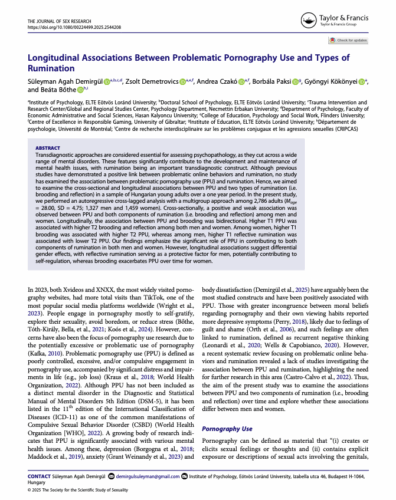
Transdiagnostic approaches are considered essential for assessing psychopathology, as they cut across a wide range of mental disorders. These features significantly contribute to the development and maintenance of mental health issues, with rumination being an important transdiagnostic construct. Although previous studies have demonstrated a positive link between problematic online behaviors and rumination, no study has examined the association between problematic pornography use (PPU) and rumination. Hence, we aimed to examine the cross-sectional and longitudinal associations between PPU and two types of rumination (i.e. brooding and reflection) in a sample of Hungarian young adults over a one year period. In the present study, we performed an autoregressive cross-lagged analysis with a multigroup approach among 2,786 adults (Mage = 28.00, SD = 4.75; 1,327 men and 1,459 women). Cross-sectionally, a positive and weak association was observed between PPU and both components of rumination (i.e. brooding and reflection) among men and women. Longitudinally, the association between PPU and brooding was bidirectional. Higher T1 PPU was associated with higher T2 brooding and reflection among both men and women. Among women, higher T1 brooding was associated with higher T2 PPU, whereas among men, higher T1 reflective rumination was associated with lower T2 PPU. Our findings emphasize the significant role of PPU in contributing to both components of rumination in both men and women. However, longitudinal associations suggest differential gender effects, with reflective rumination serving as a protective factor for men, potentially contributing to self-regulation, whereas brooding exacerbates PPU over time for women.
Relevance
Rumination has been defined as “repetitively focusing on the fact that one is depressed; on one’s symptoms of depression; and on the causes, meanings, and consequences of depressive symptoms”and “the act of continuously focusing on one’s own negative thoughts, feelings, and unpleasant experiences.” This study found that in both men and women “higher levels” problematic pornography use (PPU) were “significantly” associated with “higher levels” of rumination. Conversely, “these findings also indicate that brooding” – a more negative form of rumination, defined as “a passive and introspective demeanor that evaluates current circumstances against an unrealized, idealized standard, accompanied by a sense of regret and dissatisfaction” – “may function as a potential risk factor for PPU.”
Citation
Demirgül, S. A., Demetrovics, Z., Czakó, A., Paksi, B., Kökönyei, G., & Bőthe, B. (2025). Longitudinal Associations Between Problematic Pornography Use and Types of Rumination. Journal of sex research. https://doi.org/10.1080/00224499.2025.2544208