
Sexting

Putting the Y in cyberflashing: Exploring the prevalence and predictors of the reasons for sending unsolicited nude or sexual images.
Open Access: No.
Abstract
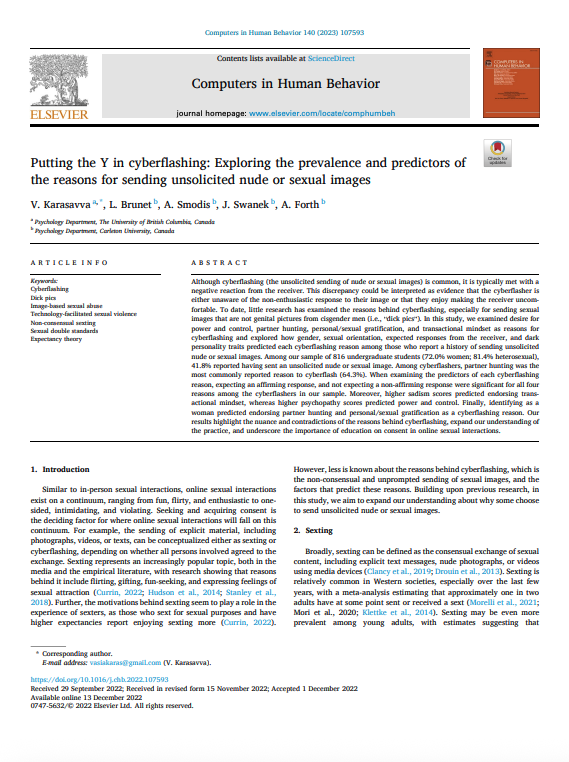
Although cyberflashing (the unsolicited sending of nude or sexual images) is common, it is typically met with a negative reaction from the receiver. This discrepancy could be interpreted as evidence that the cyberflasher is either unaware of the non-enthusiastic response to their image or that they enjoy making the receiver uncomfortable. To date, little research has examined the reasons behind cyberflashing, especially for sending sexual images that are not genital pictures from cisgender men (i.e., “dick pics”). In this study, we examined desire for power and control, partner hunting, personal/sexual gratification, and transactional mindset as reasons for cyberflashing and explored how gender, sexual orientation, expected responses from the receiver, and dark personality traits predicted each cyberflashing reason among those who report a history of sending unsolicited nude or sexual images. Among our sample of 816 undergraduate students (72.0% women; 81.4% heterosexual), 41.8% reported having sent an unsolicited nude or sexual image. Among cyberflashers, partner hunting was the most commonly reported reason to cyberflash (64.3%). When examining the predictors of each cyberflashing reason, expecting an affirming response, and not expecting a non-affirming response were significant for all four reasons among the cyberflashers in our sample. Moreover, higher sadism scores predicted endorsing transactional mindset, whereas higher psychopathy scores predicted power and control. Finally, identifying as a woman predicted endorsing partner hunting and personal/sexual gratification as a cyberflashing reason. Our results highlight the nuance and contradictions of the reasons behind cyberflashing, expand our understanding of the practice, and underscore the importance of education on consent in online sexual interactions.
Relevance
Cyberflashing “is by definition a non-consensual sexual act.” The study found, consistent with its hypothesis, that “cyberflashing was positively correlated with higher scores in self-reported measures of dark personality traits, namely, narcissism and psychopathy.”
The most common reasons for cyberflashing were “partner hunting,” to get a sexual image in return, for narcissistic self-gratification (they simply enjoy cyberflashing), and for power and control (a reason “endorsed” by 15% of the participants).
Citation
Karasavva, V., Brunet, L., Smodis, A., Swanek, J., & Forth, A. (2023). Putting the Y in cyberflashing: Exploring the prevalence and predictors of the reasons for sending unsolicited nude or sexual images. Computers in Human Behavior, 140, Article 107593. https://doi.org/10.1016/j.chb.2022.107593