Mental Health

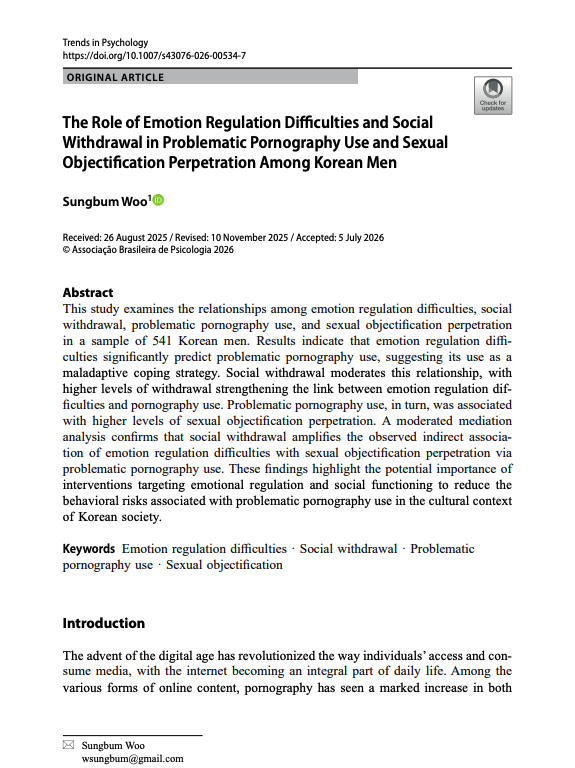
The Role of Emotion Regulation Difficulties and Social Withdrawal in Problematic Pornography Use and Sexual Objectification Perpetration Among Korean Men.
Open Access: Yes.
Abstract
This study examines the relationships among emotion regulation difficulties, social withdrawal, problematic pornography use, and sexual objectification perpetration in a sample of 541 Korean men. Results indicate that emotion regulation difficulties significantly predict problematic pornography use, suggesting its use as a maladaptive coping strategy. Social withdrawal moderates this relationship, with higher levels of withdrawal strengthening the link between emotion regulation difficulties and pornography use. Problematic pornography use, in turn, was associated with higher levels of sexual objectification perpetration. A moderated mediation analysis confirms that social withdrawal amplifies the observed indirect association of emotion regulation difficulties with sexual objectification perpetration via problematic pornography use. These findings highlight the potential importance of interventions targeting emotional regulation and social functioning to reduce the behavioral risks associated with problematic pornography use in the cultural context of Korean society.
Relevance
Among Korean men, “emotion regulation difficulties were found to be significantly associated with problematic pornography use.” This finding mirrors a “substantial body of literature” showing that excessive pornography use is a maladaptive coping strategy to alleviate or escape distress. But “pornography consumption can be negatively reinforcing… thereby increasing the risk of compulsive or addictive patterns.”
The findings of the study, too, align with “models that view problematic pornography use through an addiction framework, suggesting parallels with substance-based addictions in terms of neurobiological reward processes and tolerance.”
“This finding is particularly salient within the Korean cultural context. Traditional Korean masculinity norms, influenced by Confucian ideals of stoicism, often discourage men from expressing or even acknowledging emotional vulnerability, as doing so may be perceived as a sign of weakness… When men habitually suppress negative emotions rather than processing them adaptively (e.g., through social support or self-reflection), the unresolved distress may intensify.” In this context, problematic pornography use “may not just be a coping mechanism in general, but a culturally-reinforced solution for men who lack sanctioned outlets for emotional expression, directly strengthening the link between emotion regulation difficulties and problematic use.”
The study also found that “social withdrawal magnifies the impact of poor emotion regulation on problematic pornography use.” “Korean society maintains a high level of stigma surrounding mental illness and formal help-seeking, which is often viewed as a source of personal or familial shame… This stigma-driven avoidance of help-seeking can directly exacerbate social withdrawal” which “intensifies the reliance on solitary, maladaptive coping behaviors” such as pornography use.
The study, too, found “a robust link: between problematic pornography use and “sexual objectification.”
“In conclusion, this study underscores the intertwined roles of emotion regulation difficulties and social withdrawal in predicting problematic pornography use and, subsequently, sexual objectification perpetration among Korean men.”
Citation
Woo, S. (2026). The Role of Emotion Regulation Difficulties and Social Withdrawal in Problematic Pornography Use and Sexual Objectification Perpetration Among Korean Men. Trends in Psychology. https://doi.org/10.1007/s43076-026-00534-7