Mental Health

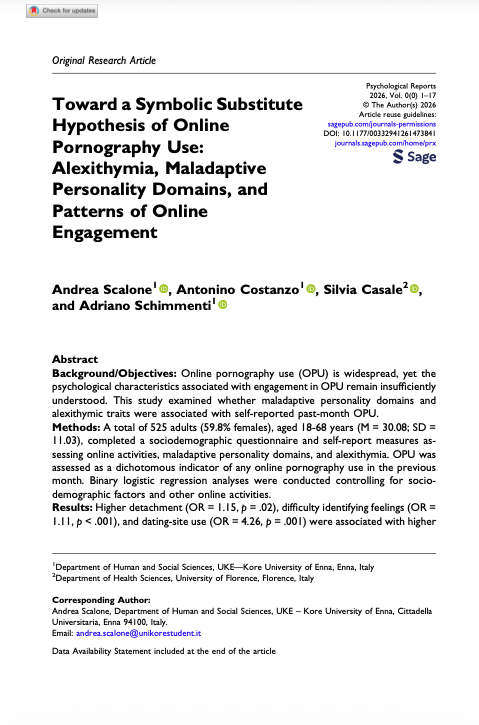
Toward a Symbolic Substitute Hypothesis of Online Pornography Use: Alexithymia, Maladaptive Personality Domains, and Patterns of Online Engagement.
Open Access: No.
Abstract
Background/Objectives
Online pornography use (OPU) is widespread, yet the psychological characteristics associated with engagement in OPU remain insufficiently understood. This study examined whether maladaptive personality domains and alexithymic traits were associated with self-reported past-month OPU.
Methods
A total of 525 adults (59.8% females), aged 18-68 years (M = 30.08; SD = 11.03), completed a sociodemographic questionnaire and self-report measures assessing online activities, maladaptive personality domains, and alexithymia. OPU was assessed as a dichotomous indicator of any online pornography use in the previous month. Binary logistic regression analyses were conducted controlling for sociodemographic factors and other online activities.
Results
Higher detachment (OR = 1.15, p = .02), difficulty identifying feelings (OR = 1.11, p < .001), and dating-site use (OR = 4.26, p = .001) were associated with higher odds of reporting past-month OPU. Being female (OR = 0.16, p < .001), psychoticism (OR = 0.88, p = .03), and externally oriented thinking (OR = 0.95, p = .04) were associated with lower odds.
Conclusions
High levels of detachment and difficulty identifying feelings were associated with the likelihood of reporting past-month OPU. The findings are compatible with the view of OPU as a possible symbolic substitute for intimacy, and suggest that, for some individuals, OPU may occur in the context of interpersonal detachment and difficulties in emotional awareness.
Relevance
This study showed “significant association” between online pornography use (OPU) and online gambling, social media use, online gaming, and use of online dating sites.
The study also found the maladaptive or pathological personality traits of detachment and difficulty identifying feelings (DIF) were also associated with OPU. This suggests “that, for some individuals, OPU may occur in the context of interpersonal distance and reduced emotional awareness.”
“The negative adjusted association of psychoticism with OPU requires cautious interpretation. Notably, psychoticism was positively related to OPU in bivariate comparisons, but its association reversed in the multivariate model. This pattern may reflect suppression or shared variance with other correlated personality and alexithymia dimensions, rather than a simple inverse relationship. Substantively, once common variance with detachment, disinhibition, negative affect, and emotional-processing difficulties is controlled, the remaining variance in psychoticism may be less related to mainstream OPU as assessed here. Because content preferences and motivations were not assessed, these interpretations remain tentative. An alternative possibility is that individuals higher in psychoticism may orient toward more idiosyncratic or non-mainstream channels of sexual fantasy or stimulation, which were not measured in the present study.”
“This study identifies alexithymia-related difficulties, especially difficulty identifying feelings, and maladaptive personality features, particularly detachment, as variables associated with the likelihood of reporting past-month OPU in a community sample. The findings are compatible with compensatory interpretations of OPU, including the possibility that, for some individuals, online pornography may function as a symbolic substitute for intimacy.”
Citation
Scalone, A., Costanzo, A., Casale, S., & Schimmenti, A. (2026). Toward a Symbolic Substitute Hypothesis of Online Pornography Use: Alexithymia, Maladaptive Personality Domains, and Patterns of Online Engagement. Psychological Reports. https://doi.org/10.1177/00332941261473841