Mental Health

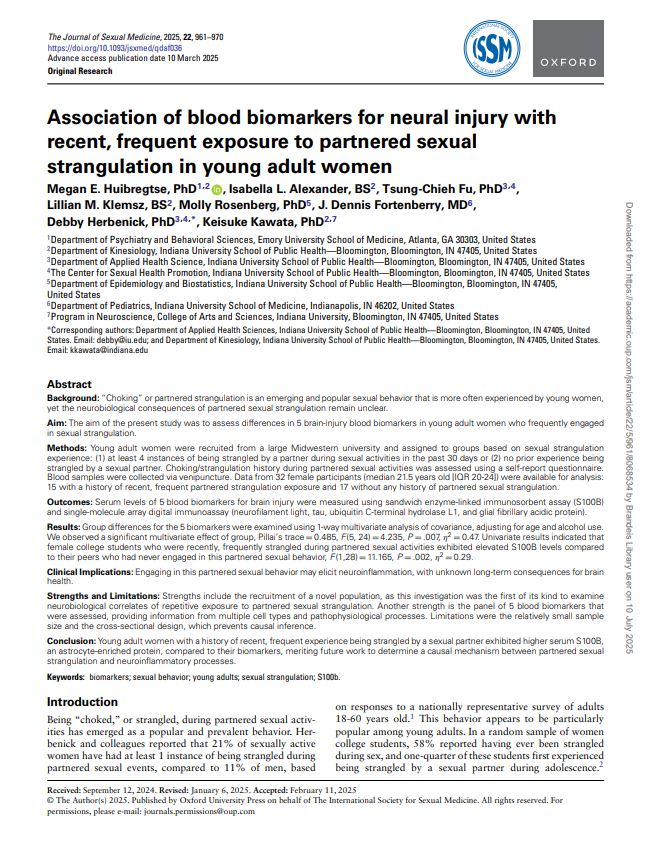
Association of blood biomarkers for neural injury with recent, frequent exposure to partnered sexual strangulation in young adult women.
Open Access: No.
Abstract
Background: “Choking” or partnered strangulation is an emerging and popular sexual behavior that is more often experienced by young women, yet the neurobiological consequences of partnered sexual strangulation remain unclear.
Aim: The aim of the present study was to assess differences in 5 brain-injury blood biomarkers in young adult women who frequently engaged in sexual strangulation.
Methods: Young adult women were recruited from a large Midwestern university and assigned to groups based on sexual strangulation experience: (1) at least 4 instances of being strangled by a partner during sexual activities in the past 30 days or (2) no prior experience being strangled by a sexual partner. Choking/strangulation history during partnered sexual activities was assessed using a self-report questionnaire. Blood samples were collected via venipuncture. Data from 32 female participants (median 21.5 years old [IQR 20-24]) were available for analysis: 15 with a history of recent, frequent partnered strangulation exposure and 17 without any history of partnered sexual strangulation.
Outcomes: Serum levels of 5 blood biomarkers for brain injury were measured using sandwich enzyme-linked immunosorbent assay (S100B) and single-molecule array digital immunoassay (neurofilament light, tau, ubiquitin C-terminal hydrolase L1, and glial fibrillary acidic protein).
Results: Group differences for the 5 biomarkers were examined using 1-way multivariate analysis of covariance, adjusting for age and alcohol use. We observed a significant multivariate effect of group, Pillai’s trace = 0.485, F(5, 24) = 4.235, P = .007, η2 = 0.47. Univariate results indicated that female college students who were recently, frequently strangled during partnered sexual activities exhibited elevated S100B levels compared to their peers who had never engaged in this partnered sexual behavior, F(1,28) = 11.165, P = .002, η2 = 0.29.
Clinical implications: Engaging in this partnered sexual behavior may elicit neuroinflammation, with unknown long-term consequences for brain health.
Strengths and limitations: Strengths include the recruitment of a novel population, as this investigation was the first of its kind to examine neurobiological correlates of repetitive exposure to partnered sexual strangulation. Another strength is the panel of 5 blood biomarkers that were assessed, providing information from multiple cell types and pathophysiological processes. Limitations were the relatively small sample size and the cross-sectional design, which prevents causal inference.
Conclusion: Young adult women with a history of recent, frequent experience being strangled by a sexual partner exhibited higher serum S100B, an astrocyte-enriched protein, compared to their biomarkers, meriting future work to determine a causal mechanism between partnered sexual strangulation and neuroinflammatory processes.
Relevance
“Partnered sexual strangulation has emerged as a popular sex behavior, particularly in young adults, and is disproportionately experienced by women. In a nationally representative survey of US adults, 35% of women under 25 years old reported that their partner had “choked”/strangled them during their most recent sexual event, compared to 2.9% of men in the same age group. Among undergraduate college students, 37% of women report a lifetime history of being choked/strangled by a partner during sex at least 5 times.”
This study investigated one way of showing the harm of non-fatal strangulation during sex: examining “blood biomarkers,” which “are objective, sensitive tools that can be used to probe neural function and pathophysiological processes in the aftermath of injury.”
“Our primary finding was that serum S100B concentrations [a blood biomarker] differed between young adult women with a history of recent, frequent exposure to partnered sexual strangulation compared to peers without any lifetime history.” This finding suggests “that transient states of hypoxia and/or ischemia through partnered sexual strangulation may have the potential to provoke neuroinflammation.”
Citation
Huibregtse, M. E., Alexander, I. L., Fu, T. C., Klemsz, L. M., Rosenberg, M., Fortenberry, J. D., Herbenick, D., & Kawata, K. (2025). Association of blood biomarkers for neural injury with recent, frequent exposure to partnered sexual strangulation in young adult women. The journal of sexual medicine, 22(5), 961–970. https://doi.org/10.1093/jsxmed/qdaf036