
Sexting

Comparing the prevalence of sexual behaviors and victimization among adolescents based on child welfare system involvement.
Open Access: No.
Abstract
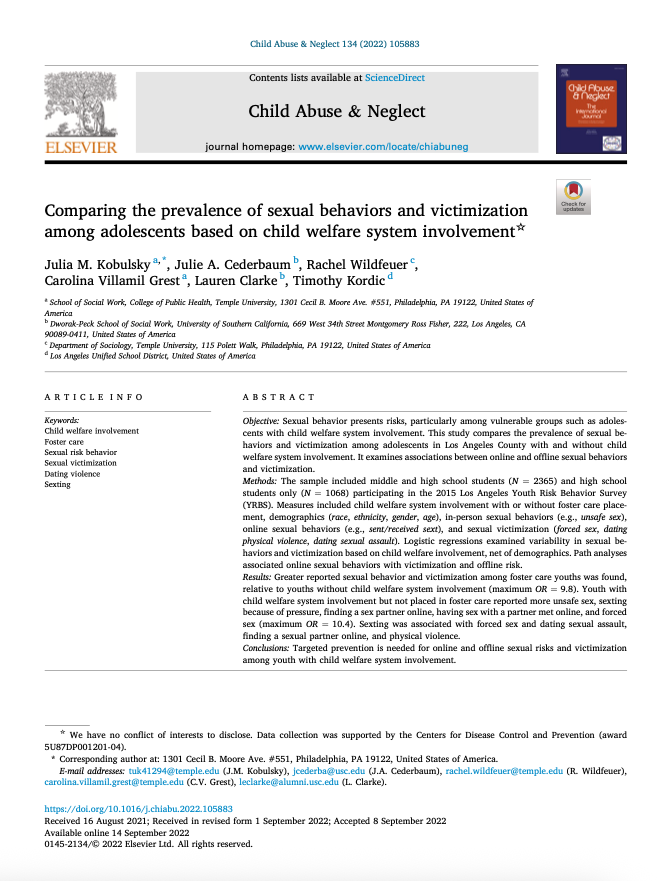
Objective: Sexual behavior presents risks, particularly among vulnerable groups such as adolescents with child welfare system involvement. This study compares the prevalence of sexual behaviors and victimization among adolescents in Los Angeles County with and without child welfare system involvement. It examines associations between online and offline sexual behaviors and victimization.
Methods: The sample included middle and high school students (N = 2365) and high school students only (N = 1068) participating in the 2015 Los Angeles Youth Risk Behavior Survey (YRBS). Measures included child welfare system involvement with or without foster care placement, demographics (race, ethnicity, gender, age), in-person sexual behaviors (e.g., unsafe sex), online sexual behaviors (e.g., sent/received sext), and sexual victimization (forced sex, dating physical violence, dating sexual assault). Logistic regressions examined variability in sexual behaviors and victimization based on child welfare involvement, net of demographics. Path analyses associated online sexual behaviors with victimization and offline risk.
Results: Greater reported sexual behavior and victimization among foster care youths was found, relative to youths without child welfare system involvement (maximum OR = 9.8). Youth with child welfare system involvement but not placed in foster care reported more unsafe sex, sexting because of pressure, finding a sex partner online, having sex with a partner met online, and forced sex (maximum OR = 10.4). Sexting was associated with forced sex and dating sexual assault, finding a sexual partner online, and physical violence.
Conclusions: Targeted prevention is needed for online and offline sexual risks and victimization among youth with child welfare system involvement.
Relevance
The results of this study of at-risk adolescents and youth “show higher prevalence of a wide range of sexual risk behaviors and sexual victimization…These include in-person sexual behavior, sexting and online sexual behaviors, forced sex, and physical dating victimization. The magnitude of group differences…were, at times, striking.” For example, nearly 25% of the foster youth sent sexual texts, or sexts, “because of pressure” as opposed to only 3% of other youth. Likewise, 31% of the foster youth had sex with someone they met online or from an app versus 4% of other youth. The foster youth, too, had much higher rates of rape and physical dating violence. These “results corroborate other research suggesting that sexting and other online sexual risk behaviors are associated with higher levels of in-person sexual risk and victimization.” The results demonstrate “significant” relationships between sexing and online sexual behaviors with in-person sexual risk and victimization.
Citation
Kobulsky, J. M., Cederbaum, J. A., Wildfeuer, R., Grest, C. V., Clarke, L., & Kordic, T. (2022). Comparing the prevalence of sexual behaviors and victimization among adolescents based on child welfare system involvement. Child abuse & neglect, 134, 105883. https://doi.org/10.1016/j.chiabu.2022.105883