Cybercrimes

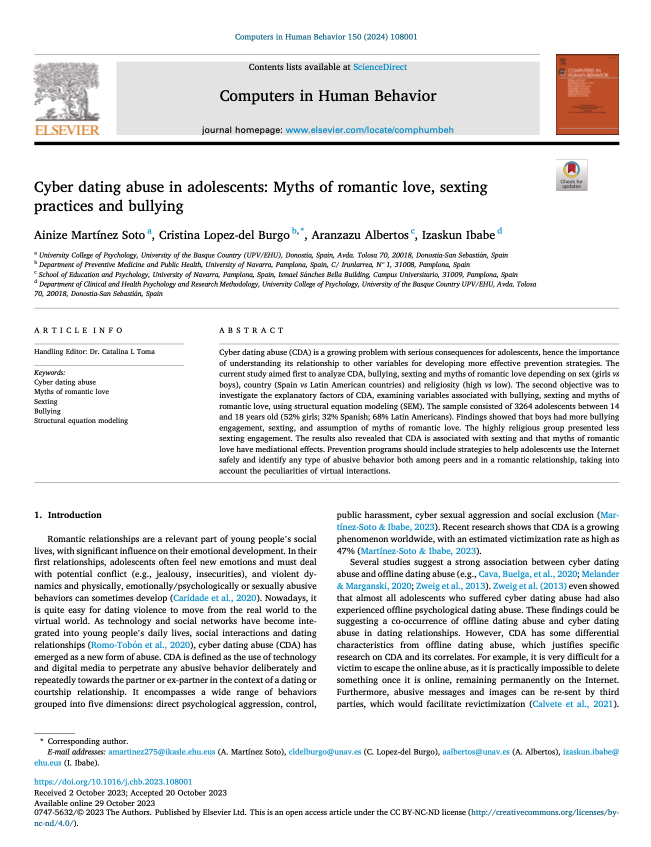
Cyber dating abuse in adolescents: Myths of romantic love, sexting practices and bullying.
Open Access: No.
Abstract
Cyber dating abuse (CDA) is a growing problem with serious consequences for adolescents, hence the importance of understanding its relationship to other variables for developing more effective prevention strategies. The current study aimed first to analyze CDA, bullying, sexting and myths of romantic love depending on sex (girls vs boys), country (Spain vs Latin American countries) and religiosity (high vs low). The second objective was to investigate the explanatory factors of CDA, examining variables associated with bullying, sexting and myths of romantic love, using structural equation modeling (SEM). The sample consisted of 3264 adolescents between 14 and 18 years old (52% girls; 32% Spanish; 68% Latin Americans). Findings showed that boys had more bullying engagement, sexting, and assumption of myths of romantic love. The highly religious group presented less sexting engagement. The results also revealed that CDA is associated with sexting and that myths of romantic love have mediational effects. Prevention programs should include strategies to help adolescents use the Internet safely and identify any type of abusive behavior both among peers and in a romantic relationship, taking into account the peculiarities of virtual interactions.
Relevance
Cyber dating abuse perpetration prevalence was 28.6%; it was higher in Latin American countries (30.07%) than Spain (24.4%). Cyber dating abuse victimization was 39.2%, with significant differences for sex (boys 41.8%; girls 37.3%); it was, again, higher in Latin America (42.4%) than Spain (33.2%). The cyber dating abuse percentages according to four categories (without violence 55%, perpetration only 6%, victimization only 17%, bidirectional violence 22%) indicate that bidirectional violence was the most frequent.
A prevalence rate for active sexting was 13.2%. Passive sexting had a total prevalence of 24.8%, with some significant differences for sex (boys 32%; girls 24.4%).
“The results revealed that CDA [cyber dating abuse] is predicted by sexting, while myths of romantic love had mediating effects.” There were no direct gender differences in CDA.
There was, however, an indirect effects of gender on CDA through myths of romantic lovel. Among males, the belief in myths of romantic love was higher, and these beliefs were positively related to CDA. Moreover, adolescents with greater internalization of myths of romantic love obtained higher scores for CDA victimization and perpetration. (In previous studies, myths of romantic love also were positively related to online control behaviors, offline aggression, and tolerant attitudes towards dating abuse.
As hypothesized, too, sexting engagement was a significant predictor of CDA.
Citation
Martínez Soto, A., Lopez-del Burgo, C., Albertos, A., & Ibabe, I. (2024). Cyber dating abuse in adolescents: Myths of romantic love, sexting practices and bullying. Computers in Human Behavior, 150, 1–11. https://doi.org/10.1016/j.chb.2023.108001