Violence

History of Strangulation Is Associated with Current Traumatic Stress, Self-Reported Vision Problems, and Other Neurobehavioral Symptoms in Women Who Have Experienced Intimate Partner Violence.
Open Access: No.
Abstract
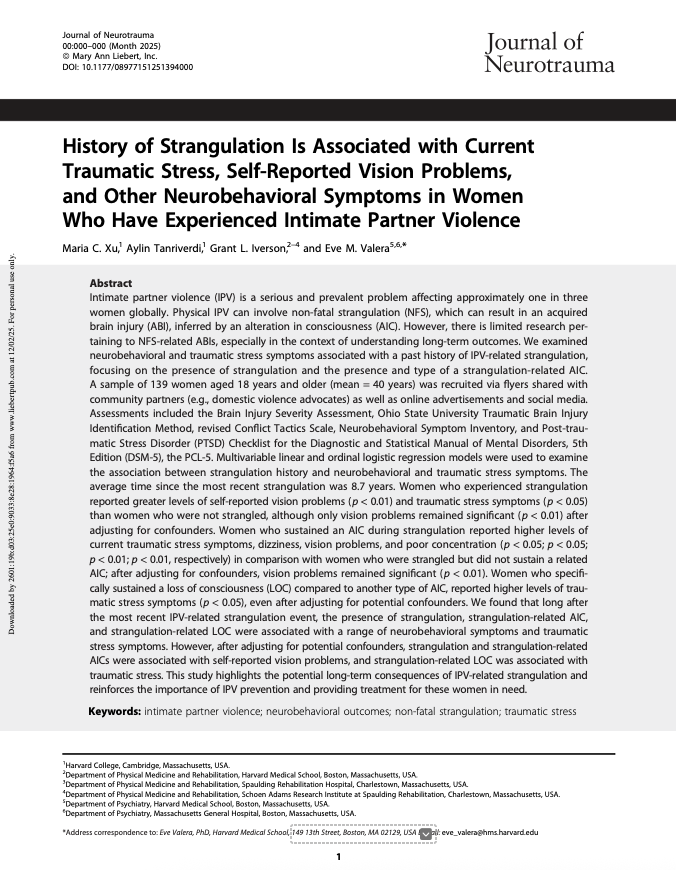
Intimate partner violence (IPV) is a serious and prevalent problem affecting approximately one in three women globally. Physical IPV can involve non-fatal strangulation (NFS), which can result in an acquired brain injury (ABI), inferred by an alteration in consciousness (AIC). However, there is limited research pertaining to NFS-related ABIs, especially in the context of understanding long-term outcomes. We examined neurobehavioral and traumatic stress symptoms associated with a past history of IPV-related strangulation, focusing on the presence of strangulation and the presence and type of a strangulation-related AIC. A sample of 139 women aged 18 years and older (mean = 40 years) was recruited via flyers shared with community partners (e.g., domestic violence advocates) as well as online advertisements and social media. Assessments included the Brain Injury Severity Assessment, Ohio State University Traumatic Brain Injury Identification Method, revised Conflict Tactics Scale, Neurobehavioral Symptom Inventory, and Post-traumatic Stress Disorder (PTSD) Checklist for the Diagnostic and Statistical Manual of Mental Disorders, 5th Edition (DSM-5), the PCL-5. Multivariable linear and ordinal logistic regression models were used to examine the association between strangulation history and neurobehavioral and traumatic stress symptoms. The average time since the most recent strangulation was 8.7 years. Women who experienced strangulation reported greater levels of self-reported vision problems (p < 0.01) and traumatic stress symptoms (p < 0.05) than women who were not strangled, although only vision problems remained significant (p < 0.01) after adjusting for confounders. Women who sustained an AIC during strangulation reported higher levels of current traumatic stress symptoms, dizziness, vision problems, and poor concentration (p < 0.05; p < 0.05; p < 0.01; p < 0.01, respectively) in comparison with women who were strangled but did not sustain a related AIC; after adjusting for confounders, vision problems remained significant (p < 0.01). Women who specifically sustained a loss of consciousness (LOC) compared to another type of AIC, reported higher levels of traumatic stress symptoms (p < 0.05), even after adjusting for potential confounders. We found that long after the most recent IPV-related strangulation event, the presence of strangulation, strangulation-related AIC, and strangulation-related LOC were associated with a range of neurobehavioral symptoms and traumatic stress symptoms. However, after adjusting for potential confounders, strangulation and strangulation-related AICs were associated with self-reported vision problems, and strangulation-related LOC was associated with traumatic stress. This study highlights the potential long-term consequences of IPV-related strangulation and reinforces the importance of IPV prevention and providing treatment for these women in need.
Relevance
This study is relevant to the ongoing and increasing practice of so-called ‘sexual choking,’ which is scientifically and medically known as non-fatal strangulation.
All the women in this study had experienced intimate partner violence (IPV). Approximately two-thirds (64%) of the women had a history of IPV-related strangulation; “30% reported strangulation related alterations in consciousness, and 15% reported strangulation-related LOC” (loss of consciousness). The women who were strangled had – years after the strangulation events – high levels of vision problems and greater traumatic stress symptomatology.” Due to the “long average time between strangulation events and the study interviews, if these symptoms began immediately or shortly after the strangulation event, the outcome measures of interest can thus be thought to represent possibly chronic neurobehavioral and traumatic stress symptoms.”
Citation
Xu, M. C., Tanriverdi, A., Iverson, G. L., & Valera, E. M. (2025). History of Strangulation Is Associated with Current Traumatic Stress, Self-Reported Vision Problems, and Other Neurobehavioral Symptoms in Women Who Have Experienced Intimate Partner Violence. Journal of Neurotrauma. https://doi.org/10.1177/08977151251394000