Mental Health

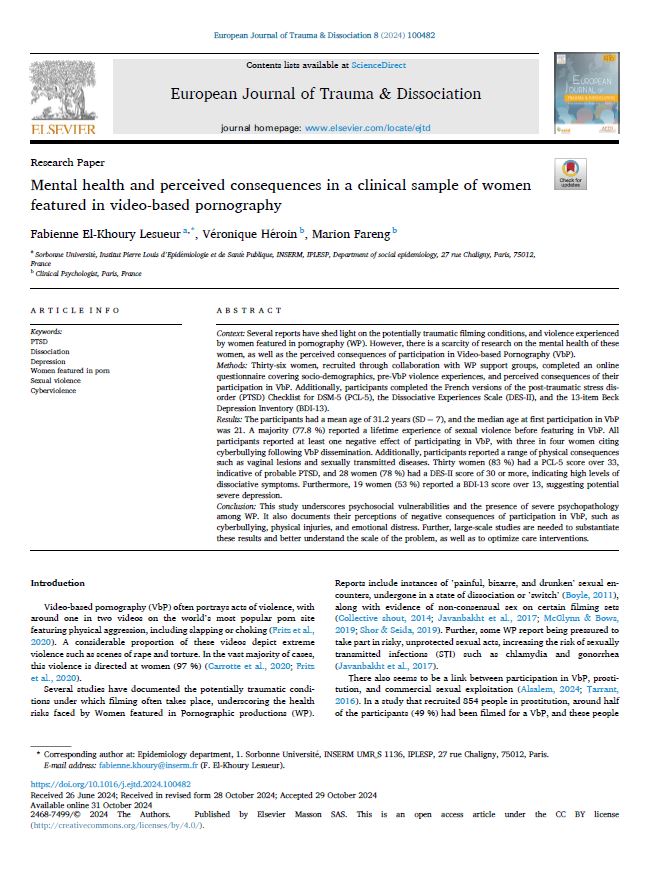
Mental health and perceived consequences in a clinical sample of women featured in video-based pornography.
Open Access: No.
Abstract
Context: Several reports have shed light on the potentially traumatic filming conditions, and violence experienced by women featured in pornography (WP). However, there is a scarcity of research on the mental health of these women, as well as the perceived consequences of participation in Video-based Pornography (VbP).
Methods: Thirty-six women, recruited through collaboration with WP support groups, completed an online questionnaire covering socio-demographics, pre-VbP violence experiences, and perceived consequences of their participation in VbP. Additionally, participants completed the French versions of the post-traumatic stress disorder (PTSD) Checklist for DSM-5 (PCL-5), the Dissociative Experiences Scale (DES-II), and the 13-item Beck Depression Inventory (BDI-13).
Results: The participants had a mean age of 31.2 years (SD = 7), and the median age at first participation in VbP was 21. A majority (77.8 %) reported a lifetime experience of sexual violence before featuring in VbP. All participants reported at least one negative effect of participating in VbP, with three in four women citing cyberbullying following VbP dissemination. Additionally, participants reported a range of physical consequences such as vaginal lesions and sexually transmitted diseases. Thirty women (83 %) had a PCL-5 score over 33, indicative of probable PTSD, and 28 women (78 %) had a DES-II score of 30 or more, indicating high levels of dissociative symptoms. Furthermore, 19 women (53 %) reported a BDI-13 score over 13, suggesting potential severe depression.
Conclusion: This study underscores psychosocial vulnerabilities and the presence of severe psychopathology among WP. It also documents their perceptions of negative consequences of participation in VbP, such as cyberbullying, physical injuries, and emotional distress. Further, large-scale studies are needed to substantiate these results and better understand the scale of the problem, as well as to optimize care interventions.
Relevance
A majority (61.1 %) of the women left the education system at the age of 19 or earlier – which was lower than in the general population.
The majority of the women had a “rather low socio-economic status.”
More than three-quarters (77.8 %) reported being victims of sexual violence before performing in pornography – which as “significantly” higher than the general population.
All but three of the women (92 %) had experienced either sexual violence and/or a traumatic life event before performing in pornography.
One-third of participants rated their general health as poor or very poor.
A majority (64 %) used sleeping aids, including sleeping pills, anxiolytics, and relaxing agents.
“A significant portion (64 %) reported participation [in pornography] under some form of threat or coercion…Several women recounted instances of coercion or “manipulation” either by a boyfriend or a female online acquaintance who portrayed VbP [video-based pornography] as “fun” or “glamourous”.” Additionally, some of the women “cited self-harm as their reason for participation” and some “reported being filmed without their knowledge.”
Almost three-quarters (70%) experienced at least one physical consequence as a result of participating in pornography, including STI or genital ‘irritations’, such as yeast infections and genital herpes, vaginal lesions, anal lesion, and digestive disorders. “Despite this question’s emphasis on physical consequences, women spontaneously disclosed psychological effects in the semi-open responses. These included eating disorders, sleep disturbances, anxiety, depression, and suicidal thoughts.”
All the women reported “at least one negative effect” of their participation in pornography, including “significant deterioration in their mental health” and cyberbullying. Most of the women reported “several adverse consequences” of their participation in pornography.
More than 80% of the women had scores on psychological testing “indicative of probable PTSD” and 78 %) had scores “indicating high levels of dissociation.” More than half (53 %) had scores indicating depression, and 44% had scores which indicated “severe depression.”
In sum, the study found a “notably high prevalence of significant distress, potential PTSD symptoms, dissociative experiences, and depressive symptoms” among women who participate in pornography.
Citation
El-Khoury Lesueur, F., Héroin, V., & Fareng, M. (2024). Mental health and perceived consequences in a clinical sample of women featured in video-based pornography. European Journal of Trauma & Dissociation, 8(4), Article 100482. https://doi.org/10.1016/j.ejtd.2024.100482