Sexting

Nonconsensual Dissemination of Sexual Images Among Adolescents: Associations With Depression and Self-Esteem.
Open Access: No.
Abstract
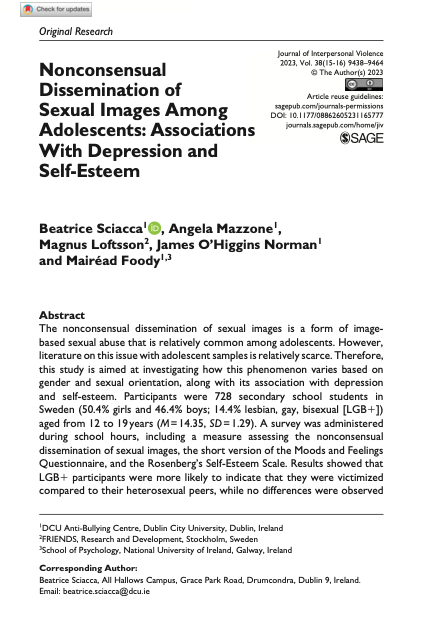
The nonconsensual dissemination of sexual images is a form of image-based sexual abuse that is relatively common among adolescents. However, literature on this issue with adolescent samples is relatively scarce. Therefore, this study is aimed at investigating how this phenomenon varies based on gender and sexual orientation, along with its association with depression and self-esteem. Participants were 728 secondary school students in Sweden (50.4% girls and 46.4% boys; 14.4% lesbian, gay, bisexual [LGB+]) aged from 12 to 19 years (M = 14.35, SD = 1.29). A survey was administered during school hours, including a measure assessing the nonconsensual dissemination of sexual images, the short version of the Moods and Feelings Questionnaire, and the Rosenberg’s Self-Esteem Scale. Results showed that LGB+ participants were more likely to indicate that they were victimized compared to their heterosexual peers, while no differences were observed for gender. Being the target of nonconsensual dissemination of sexual images was positively associated with depression, whereas no significant associations were yielded for self-esteem. Based on the findings from this study, we suggest raising adolescent awareness in relation to the nonconsensual dissemination of sexual images as a form of sexual abuse that can have detrimental effects on those who are targeted. Such educational programs should be inclusive of sexual minority adolescents, as they are at a particular risk of being the target of nonconsensual dissemination of sexual images. Psychological support should be provided to the targets of this form of abuse, through both school and online counseling. Future research should adopt longitudinal designs while recruiting diverse samples.
Relevance
This study showed that sexual minority adolescents were more than twice as likely as heterosexual youth to be the target of nonconsensual dissemination of sexual images.
The study also found an association between depression and being the target of nonconsensual dissemination of sexual images.
Citation
Sciacca, B., Mazzone, A., Loftsson, M., O’Higgins Norman, J., & Foody, M. (2023). Nonconsensual Dissemination of Sexual Images Among Adolescents: Associations With Depression and Self-Esteem. Journal of interpersonal violence, 38(15-16), 9438–9464. https://doi.org/10.1177/08862605231165777