Mental Health

Pornography use, problematic pornography use, impulsivity, and sensation seeking: a meta-analysis.
Open Access: No.
Abstract
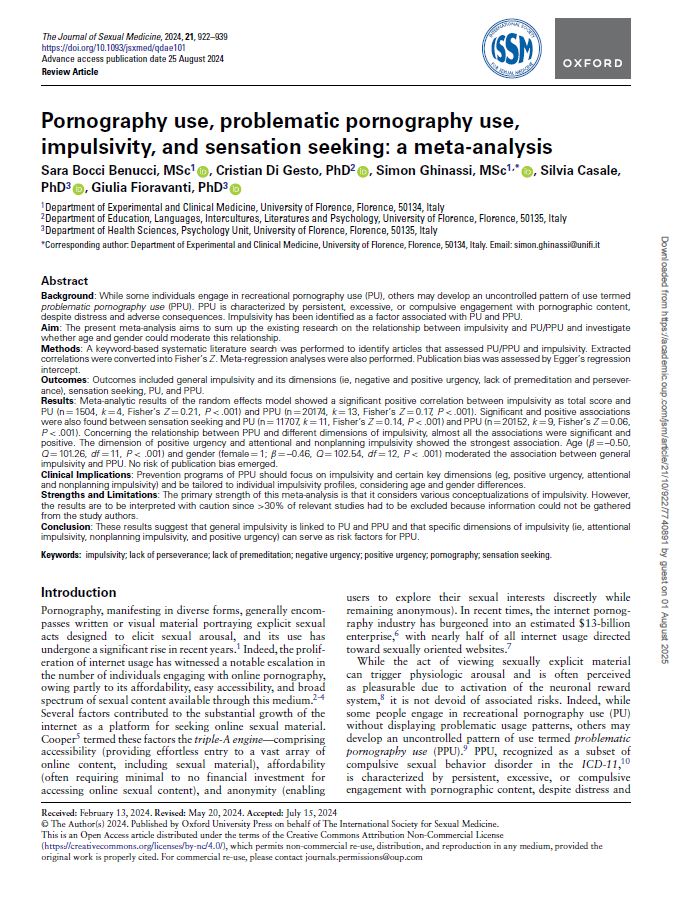
Background: While some individuals engage in recreational pornography use (PU), others may develop an uncontrolled pattern of use termed problematic pornography use (PPU). PPU is characterized by persistent, excessive, or compulsive engagement with pornographic content, despite distress and adverse consequences. Impulsivity has been identified as a factor associated with PU and PPU.
Aim: The present meta-analysis aims to sum up the existing research on the relationship between impulsivity and PU/PPU and investigate whether age and gender could moderate this relationship.
Methods: A keyword-based systematic literature search was performed to identify articles that assessed PU/PPU and impulsivity. Extracted correlations were converted into Fisher’s Z. Meta-regression analyses were also performed. Publication bias was assessed by Egger’s regression intercept.
Outcomes: Outcomes included general impulsivity and its dimensions (ie, negative and positive urgency, lack of premeditation and perseverance), sensation seeking, PU, and PPU.
Results: Meta-analytic results of the random effects model showed a significant positive correlation between impulsivity as total score and PU (n = 1504, k = 4, Fisher’s Z = 0.21, P < .001) and PPU (n = 20174, k = 13, Fisher’s Z = 0.17, P < .001). Significant and positive associations were also found between sensation seeking and PU (n = 11707, k = 11, Fisher’s Z = 0.14, P < .001) and PPU (n = 20152, k = 9, Fisher’s Z = 0.06, P < .001). Concerning the relationship between PPU and different dimensions of impulsivity, almost all the associations were significant and positive. The dimension of positive urgency and attentional and nonplanning impulsivity showed the strongest association. Age (β = -0.50, Q = 101.26, df = 11, P < .001) and gender (female = 1; β = -0.46, Q = 102.54, df = 12, P < .001) moderated the association between general impulsivity and PPU. No risk of publication bias emerged.
Clinical implications: Prevention programs of PPU should focus on impulsivity and certain key dimensions (eg, positive urgency, attentional and nonplanning impulsivity) and be tailored to individual impulsivity profiles, considering age and gender differences.
Strengths and limitations: The primary strength of this meta-analysis is that it considers various conceptualizations of impulsivity. However, the results are to be interpreted with caution since >30% of relevant studies had to be excluded because information could not be gathered from the study authors.
Conclusion: These results suggest that general impulsivity is linked to PU and PPU and that specific dimensions of impulsivity (ie, attentional impulsivity, nonplanning impulsivity, and positive urgency) can serve as risk factors for PPU.
Relevance
The study found a positive correlation between impulsivity and both PPU [problematic pornography use] and PU [“recreational pornography use”]. “These results suggest that individuals with higher levels of impulsivity are more likely to use pornography and engage in PPU.”
Additionally, “individuals may impulsively turn to pornography, driven by a desire for immediate gratification and arousal when experiencing positive emotions. It is possible that this inclination makes them more susceptible to adopting compulsive or problematic patterns of pornography consumption.” That some users turn to pornography without premeditation shows that they “might impulsively involved themselves in PU without contemplating potential negative consequences.”
The study found only a “relatively small” positive correlation between sensation seeking and PU and PPU. Yet, “for some high sensation seekers, pornography may serve as a coping mechanism…to alleviate boredom, stress, or negative emotions.”
Citation
Bocci Benucci, S., Di Gesto, C., Ghinassi, S., Casale, S., & Fioravanti, G. (2024). Pornography use, problematic pornography use, impulsivity, and sensation seeking: a meta-analysis. The journal of sexual medicine, 21(10), 922–939. https://doi.org/10.1093/jsxmed/qdae101