Rates, Age, & Impact of Exposure to Pornography

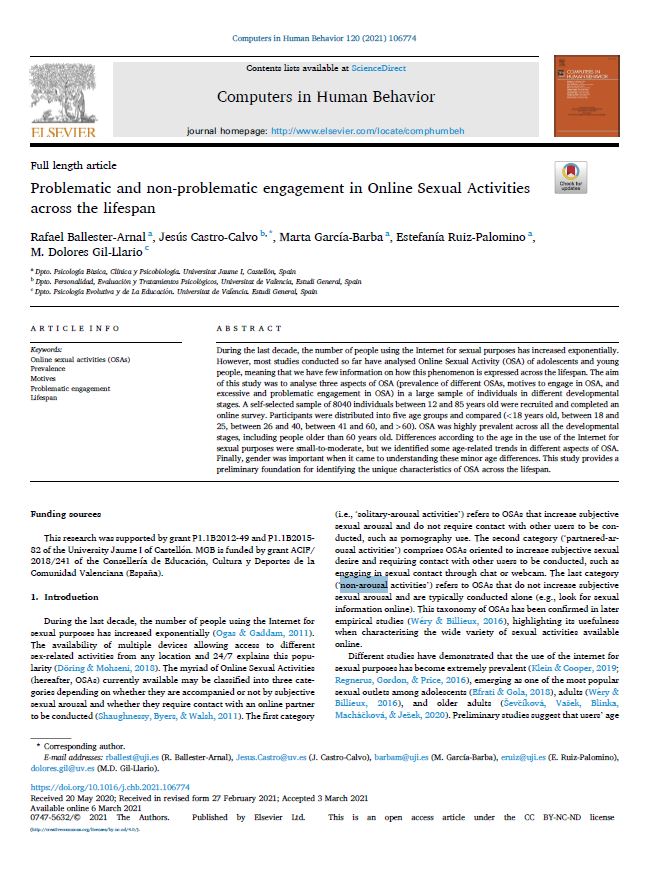
Problematic and non-problematic engagement in Online Sexual Activities across the lifespan.
Open Access: Yes.
Abstract
During the last decade, the number of people using the Internet for sexual purposes has increased exponentially. However, most studies conducted so far have analysed Online Sexual Activity (OSA) of adolescents and young people, meaning that we have few information on how this phenomenon is expressed across the lifespan. The aim of this study was to analyse three aspects of OSA (prevalence of different OSAs, motives to engage in OSA, and excessive and problematic engagement in OSA) in a large sample of individuals in different developmental stages. A self-selected sample of 8040 individuals between 12 and 85 years old were recruited and completed an online survey. Participants were distributed into five age groups and compared (<18 years old, between 18 and 25, between 26 and 40, between 41 and 60, and >60). OSA was highly prevalent across all the developmental stages, including people older than 60 years old. Differences according to the age in the use of the Internet for sexual purposes were small-to-moderate, but we identified some age-related trends in different aspects of OSA. Finally, gender was important when it came to understanding these minor age differences. This study provides a preliminary foundation for identifying the unique characteristics of OSA across the lifespan.
Relevance
“In men, adults and older adults spent almost twice as long on the Internet for sexual purposes than early adolescents and adolescents, young adults, and elderly (about 7 h per week vs. 3–4 h). In women, time spent online for sexual purposes barely changed with age.”
During early adolescence, adolescence, and young adulthood, “non-arousal OSAs [online sexual activities] such as reading erotica online or the use of the Internet to find sexual education were extremely popular (prevalence between 77.8% and 81.7% in men and 89.7%–90.9% in women), together with certain solitary-OSAs aimed to achieve sexual satisfaction (e.g., pornography use)”.
During during adulthood (26-40 years old), “non-arousal OSAs became less relevant, solitary-OSAs remained stable, and partnered arousal OSAs (mainly, the use of chats or webcams for sexual purposes) gained prominence until achieving their peak prevalence”.
During middle adulthood (41-60 years old), “solitary-arousal OSAs emerged as the most popular online sexual outlet, whereas partnered-arousal OSAs started to lose relevance”.
Last, during late adulthood (60 years or older), “the prevalence of all the OSAs assessed tended to decline (especially in women).”
Citation
Ballester-Arnal, R., Castro-Calvo, J., García-Barba, M., Ruiz-Palomino, E., & Gil-Llario, M. D. (2021). Problematic and non-problematic engagement in Online Sexual Activities across the lifespan. Computers in Human Behavior, 120, Article 106774. https://doi.org/10.1016/j.chb.2021.106774