Mental Health

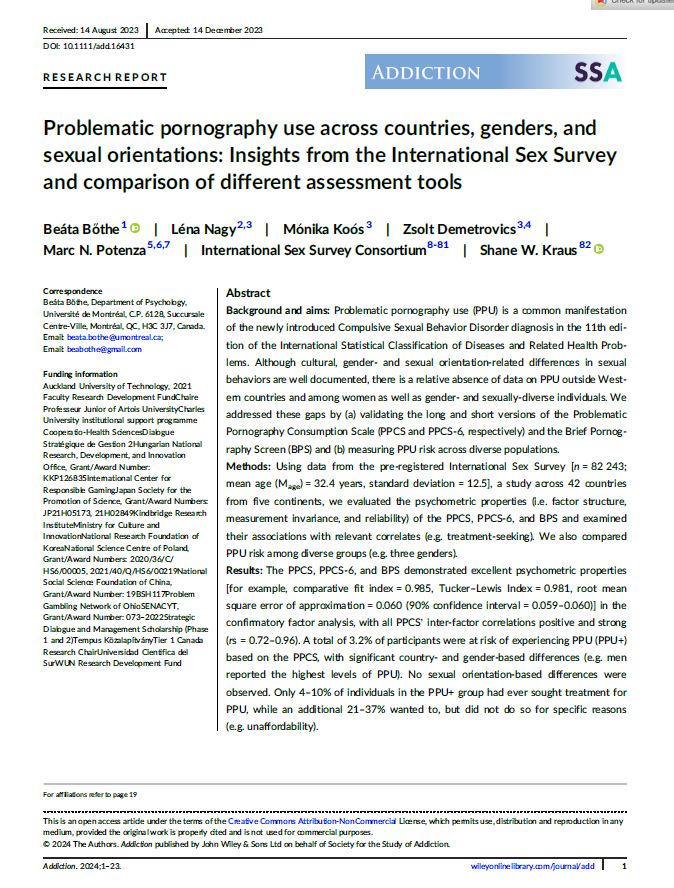
Problematic pornography use across countries, genders, and sexual orientations: Insights from the International Sex Survey and comparison of different assessment tools.
Open Access: Yes.
Abstract
Background and aims: Problematic pornography use (PPU) is a common manifestation of the newly introduced Compulsive Sexual Behavior Disorder diagnosis in the 11th edition of the International Statistical Classification of Diseases and Related Health Problems. Although cultural, gender- and sexual orientation-related differences in sexual behaviors are well documented, there is a relative absence of data on PPU outside Western countries and among women as well as gender- and sexually-diverse individuals. We addressed these gaps by (a) validating the long and short versions of the Problematic Pornography Consumption Scale (PPCS and PPCS-6, respectively) and the Brief Pornography Screen (BPS) and (b) measuring PPU risk across diverse populations.
Methods: Using data from the pre-registered International Sex Survey [n = 82 243; mean age (Mage) = 32.4 years, standard deviation = 12.5], a study across 42 countries from five continents, we evaluated the psychometric properties (i.e. factor structure, measurement invariance, and reliability) of the PPCS, PPCS-6, and BPS and examined their associations with relevant correlates (e.g. treatment-seeking). We also compared PPU risk among diverse groups (e.g. three genders).
Results: The PPCS, PPCS-6, and BPS demonstrated excellent psychometric properties [for example, comparative fit index = 0.985, Tucker-Lewis Index = 0.981, root mean square error of approximation = 0.060 (90% confidence interval = 0.059-0.060)] in the confirmatory factor analysis, with all PPCS’ inter-factor correlations positive and strong (rs = 0.72-0.96). A total of 3.2% of participants were at risk of experiencing PPU (PPU+) based on the PPCS, with significant country- and gender-based differences (e.g. men reported the highest levels of PPU). No sexual orientation-based differences were observed. Only 4-10% of individuals in the PPU+ group had ever sought treatment for PPU, while an additional 21-37% wanted to, but did not do so for specific reasons (e.g. unaffordability).
Conclusions: This study validated three measures to assess the severity of problematic pornography use across languages, countries, genders, and sexual orientations in 26 languages: the Problematic Pornography Consumption Scale (PPCS, and PPCS-6, respectively), and the Brief Pornography Screen (BPS). The problematic pornography use risk is estimated to be 3.2-16.6% of the population of 42 countries, and varies among different groups (e.g. genders) and based on the measure used.
Relevance
Overall, 3.2–16.6% of individuals across these countries were at risk of experiencing problematic pornography use (PPU).
Furthermore, the study found that “strikingly, only 4–10% of the individuals in the PPU+ group [at risk] sought treatment for PPU, while an additional 21–37% did not do so due to various reasons (e.g. stigma, unaffordability). Clearly, there is a need for better access to PPU treatment”.
“Our arguably conservative occurrence estimate of 3.2% makes PPU as prevalent as many other mental health issues”.
Citation
Bőthe, B., Nagy, L., Koós, M., Demetrovics, Z., Potenza, M. N., International Sex Survey Consortium, & Kraus, S. W. (2024). Problematic pornography use across countries, genders, and sexual orientations: Insights from the International Sex Survey and comparison of different assessment tools. Addiction, 119(5), 928–950. https://doi.org/10.1111/add.16431