Reports & Summaries

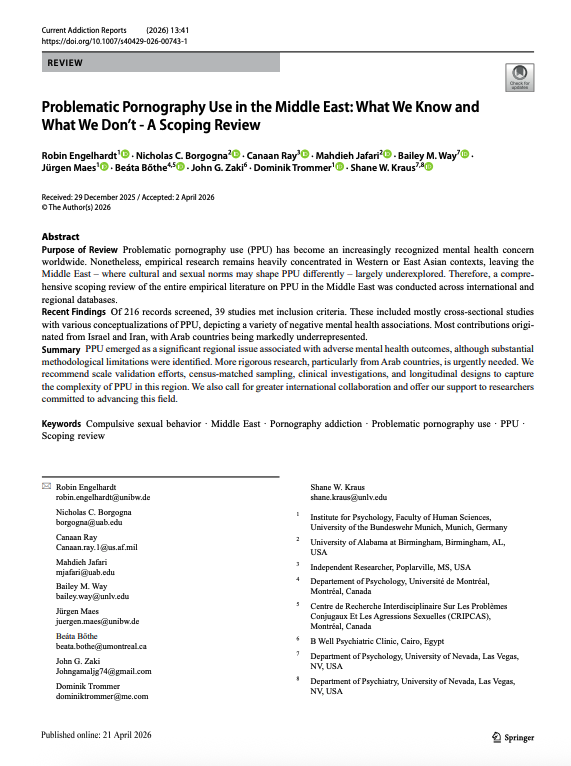
Problematic Pornography Use in the Middle East: What We Know and What We Don’t – A Scoping Review.
Open Access: Yes.
Abstract
Purpose of Review
Problematic pornography use (PPU) has become an increasingly recognized mental health concern worldwide. Nonetheless, empirical research remains heavily concentrated in Western or East Asian contexts, leaving the Middle East – where cultural and sexual norms may shape PPU differently – largely underexplored. Therefore, a comprehensive scoping review of the entire empirical literature on PPU in the Middle East was conducted across international and regional databases.
Recent Findings
Of 216 records screened, 39 studies met inclusion criteria. These included mostly cross-sectional studies with various conceptualizations of PPU, depicting a variety of negative mental health associations. Most contributions originated from Israel and Iran, with Arab countries being markedly underrepresented.
Summary
PPU emerged as a significant regional issue associated with adverse mental health outcomes, although substantial methodological limitations were identified. More rigorous research, particularly from Arab countries, is urgently needed. We recommend scale validation efforts, census-matched sampling, clinical investigations, and longitudinal designs to capture the complexity of PPU in this region. We also call for greater international collaboration and offer our support to researchers committed to advancing this field.
Relevance
“Although overall research remains limited, the reviewed evidence indicates that PPU [problematic pornography use] might be prevalent and linked to negative mental health outcomes in the Middle East, while treatment options remain insufficiently explored.” This region is “characterized by religious and cultural stigma around sexuality.” Hence, “pornography-related anxiety, depression, and moral distress may be easily overlooked in psychiatric settings. Clinicians in this region should therefore consider systematic screening of patients, particularly young male patients reporting depression and anxiety symptoms. When identifying PPU, we recommend clinicians approach patients with compassion, while addressing potential religious and moral struggles alongside their dysregulated pornography use. We also recommend that clinicians integrate patients’ religious worldview into psychotherapy instead of aiming at the complete extinction of sexual desire.”
“The available evidence suggests that PPU [problematic pornography use] might be commonly experienced and linked to generally negative mental health outcomes in this region. The absence of comparable research from most Arabic-speaking countries suggests possible cultural or structural barriers. Addressing these gaps will require greater contributions from Arabic-speaking countries, international cooperation, as well as more clinical, longitudinal, and additional census-matched studies from across the region.”
Citation
Engelhardt, R., Borgogna, N. C., Ray, C., Jafari, M., Way, B. M., Maes, J.,Bőthe, B., Zaki, J. G., Trommer, D., & Kraus, S. W. (2026). Problematic Pornography Use in the Middle East: What We Know and What We Don’t – A Scoping Review. Current Addiction Reports, 13, Article 41. https://doi.org/10.1007/s40429-026-00743-1