Violence

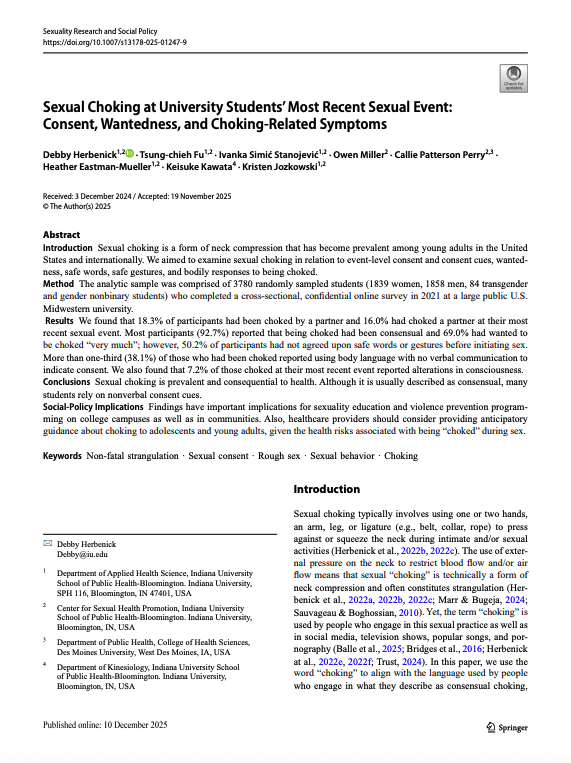
Sexual Choking at University Students’ Most Recent Sexual Event: Consent, Wantedness, and Choking-Related Symptoms.
Open Access: Yes.
Abstract
Introduction
Sexual choking is a form of neck compression that has become prevalent among young adults in the United States and internationally. We aimed to examine sexual choking in relation to event-level consent and consent cues, wantedness, safe words, safe gestures, and bodily responses to being choked.
Method
The analytic sample was comprised of 3780 randomly sampled students (1839 women, 1858 men, 84 transgender and gender nonbinary students) who completed a cross-sectional, confidential online survey in 2021 at a large public U.S. Midwestern university.
Results
We found that 18.3% of participants had been choked by a partner and 16.0% had choked a partner at their most recent sexual event. Most participants (92.7%) reported that being choked had been consensual and 69.0% had wanted to be choked “very much”; however, 50.2% of participants had not agreed upon safe words or gestures before initiating sex. More than one-third (38.1%) of those who had been choked reported using body language with no verbal communication to indicate consent. We also found that 7.2% of those choked at their most recent event reported alterations in consciousness.
Conclusions
Sexual choking is prevalent and consequential to health. Although it is usually described as consensual, many students rely on nonverbal consent cues.
Social-Policy Implications
Findings have important implications for sexuality education and violence prevention programming on college campuses as well as in communities. Also, healthcare providers should consider providing anticipatory guidance about choking to adolescents and young adults, given the health risks associated with being “choked” during sex.
Relevance
[Note: So-called “sexual choking” is more properly termed “non-fatal strangulation.”]
Among these university students, “those who reported having been choked during their most recent sexual event were more often women and TGNB+ [transgender and nonbinary] students. In contrast, those who reported having choked their partner during their most recent sexual event were more often men and TGNB+students. These data align with representations of sexual choking in social media, pornography, and mainstream media articles about choking, in which women are more often depicted or described as being choked and men are more often depicted or described as choking their partner(s) and gender (TGNB+) nonbinary students.”
“A first major finding is that the vast majority of participants who had been choked at their most recent sexual event described being choked as “very much” consensual but somewhat fewer (about two-thirds) indicated that they had wanted to be choked “very much.””
“Women and TGNB+students…reported a greater desire to be choked than men did.”
“A second major finding is that only about 1 in 6 participants who had been choked reported that they and their partner had agreed upon both safe words and safe gestures before having sex.” That said, “people may not be able to use their safe words while being choked due to an inability to speak or breathe while being choked.” They may also not be able to use safe gestures if they are feeling dizzy, disoriented, about to pass out, and so forth.
“Third, although slightly more than half of participants who had been choked reported using some form of explicit verbal communication, many of those who had choked their partner described relying on “no response signals” (i.e., their partner’s lack of refusal) or on non-verbal cues to interpret consent” – which is likely to work “reasonably well” only with “established partners” and then only “if the power dynamics support each partner in feeling free to accept or decline choking/being choked. Yet, people may not feel free to refuse being choked or be able to communicate a refusal if their partner already has their hand on their neck or is starting to choke them, especially given that strangulation is often used to threaten, intimate, or harm others.” And unequal power dynamics are visible in the fact that men are more likely to choke women rather than vice versa.
Fourth, the study found “high levels of pleasurable sensations/euphoria reported” from sexual choking. But the long term effects of this practice are not-known, and the short-term effects from cerebral hypoxia (or choking) can include damage to the brain, impaired cognition and memory, reduced fine motor skills, and, as reported by respondents, neck swelling, involuntary urination, and loss of consciousness which “suggests probably brain injury.”
Fifth, some study participants reported the sexual choking as non-consensual, which is sexual assault. Much like people who fail to recognize what is called “unacknowledged rape,” it may be that, since sexual choking is so routine now, some people don’t consider non-consensual choking to be assault.” Along these lines, note that 24% of those who choked a partner without verbal consent judged the choking to be consensual because of the absence of a verbal “no” or the lack of resistance.
Citation
Herbenick, D., Fu, T-c., Simić Stanojević, I., Miller, O., Patterson Perry, C., Eastman-Mueller, H., Kawata, K., & Jozkowski, K. (2025). Sexual Choking at University Students’ Most Recent Sexual Event: Consent, Wantedness, and Choking-Related Symptoms. Sexuality Research and Social Policy. https://doi.org/10.1007/s13178-025-01247-9