Child-on-child (Peer-on-peer) Sexual Abuse

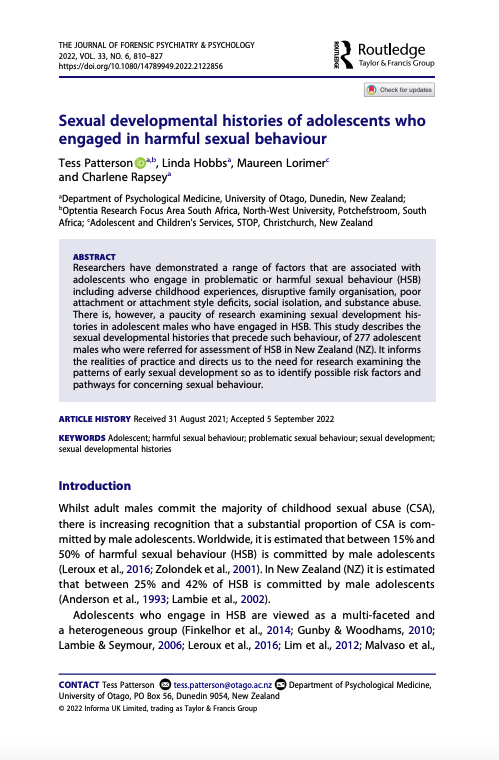
Sexual developmental histories of adolescents who engaged in harmful sexual behaviour.
Open Access: No.
Abstract
Researchers have demonstrated a range of factors that are associated with adolescents who engage in problematic or harmful sexual behaviour (HSB) including adverse childhood experiences, disruptive family organisation, poor attachment or attachment style deficits, social isolation, and substance abuse. There is, however, a paucity of research examining sexual development histories in adolescent males who have engaged in HSB. This study describes the sexual developmental histories that precede such behaviour, of 277 adolescent males who were referred for assessment of HSB in New Zealand (NZ). It informs the realities of practice and directs us to the need for research examining the patterns of early sexual development so as to identify possible risk factors and pathways for concerning sexual behaviour.
Relevance
This article did not endorse the use of pornography as an antecedent or risk factor in the developmental history of adolescents who engage in harmful sexual behaviors towards other children. But the article still noted several items of importance that support this relationships:
85.6% of these adolescents in the study had been exposed to pornography. The mean age of first exposure was 10 years old, which is much lower than the age of 13+ reported by most boys for first exposure. Some of the boys in the study first viewed pornography at or before 5 years old. 7.6% were exposed to child pornography; 4.3% were exposed to bestiality. Almost 50% had sustained exposure to pornography over a period of time.
Citation
Patterson, T., Hobbs, L., Lorimer, M., & Rapsey, C. (2022). Sexual developmental histories of adolescents who engaged in harmful sexual behaviour. The Journal of Forensic Psychiatry & Psychology, 33(6), 810–827. https://doi.org/10.1080/14789949.2022.2122856