Mental Health

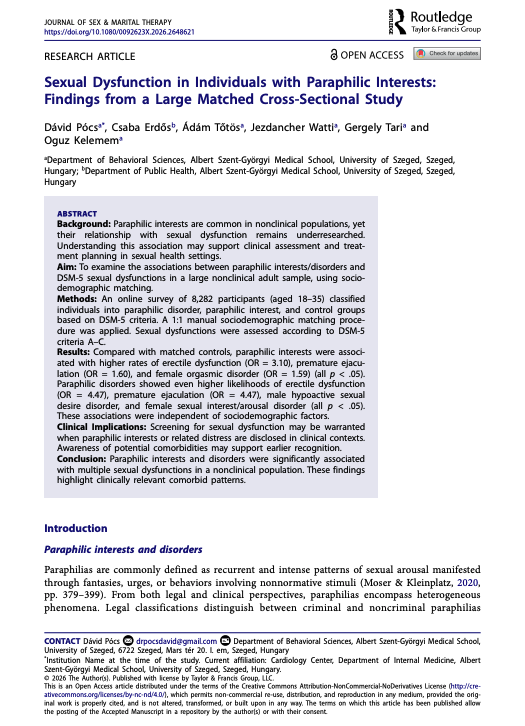
Sexual Dysfunction in Individuals with Paraphilic Interests: Findings from a Large Matched Cross-Sectional Study.
Open Access: Yes.
Abstract
Background
Paraphilic interests are common in nonclinical populations, yet their relationship with sexual dysfunction remains underresearched. Understanding this association may support clinical assessment and treatment planning in sexual health settings.
Aim
To examine the associations between paraphilic interests/disorders and DSM-5 sexual dysfunctions in a large nonclinical adult sample, using sociodemographic matching.
Methods
An online survey of 8,282 participants (aged 18–35) classified individuals into paraphilic disorder, paraphilic interest, and control groups based on DSM-5 criteria. A 1:1 manual sociodemographic matching procedure was applied. Sexual dysfunctions were assessed according to DSM-5 criteria A–C.
Results
Compared with matched controls, paraphilic interests were associated with higher rates of erectile dysfunction (OR = 3.10), premature ejaculation (OR = 1.60), and female orgasmic disorder (OR = 1.59) (all p < .05). Paraphilic disorders showed even higher likelihoods of erectile dysfunction (OR = 4.47), premature ejaculation (OR = 4.47), male hypoactive sexual desire disorder, and female sexual interest/arousal disorder (all p < .05). These associations were independent of sociodemographic factors.
Clinical Implications
Screening for sexual dysfunction may be warranted when paraphilic interests or related distress are disclosed in clinical contexts. Awareness of potential comorbidities may support earlier recognition.
Conclusion
Paraphilic interests and disorders were significantly associated with multiple sexual dysfunctions in a nonclinical population. These findings highlight clinically relevant comorbid patterns.
Relevance
Paraphilias are commonly defined as recurrent and intense patterns of sexual arousal manifested through fantasies, urges, or behaviors involving nonnormative stimuli. Examples are pedophilia, voyeurism, exhibitionism, frotteuristic disorder (rubbing against a non-consenting persons), and sexual sadism.
“Based on the magnitude of effect, the most prominent factor is exposure to pornography (OR = 3.85), followed by early exposure to pornography (OR = 2.04).”
“Based on our results, we propose that the age at first exposure to pornography and childhood sexual abuse are likely to be developmentally associated with self-reported paraphilic disorders.”
Earlier exposure to pornographic content was associated with a 3.28 times higher likelihood of reporting paraphilic disorder and with a 2.04 times higher likelihood of reporting paraphilic interest than a late encounter with pornographic content.
“Early exposure to pornographic content and childhood sexual abuse may be developmentally associated with paraphilic disorder.”
Citation
Pócs, D., Erdős, C., Tőtös, Á., Watti, J., Tari, G., & Kelemem, O. (2026). Sexual Dysfunction in Individuals with Paraphilic Interests: Findings from a Large Matched Cross-Sectional Study. Journal of Sex & Marital Therapy. https://doi.org/10.1080/0092623X.2026.2648621