Cybercrimes

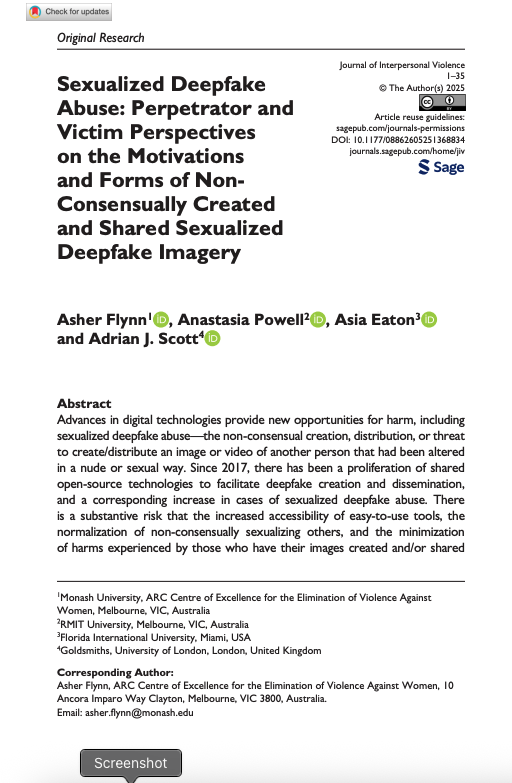
Sexualized Deepfake Abuse: Perpetrator and Victim Perspectives on the Motivations and Forms of Non-Consensually Created and Shared Sexualized Deepfake Imagery.
Open Access: Yes.
Abstract
Advances in digital technologies provide new opportunities for harm, including sexualized deepfake abuse-the non-consensual creation, distribution, or threat to create/distribute an image or video of another person that had been altered in a nude or sexual way. Since 2017, there has been a proliferation of shared open-source technologies to facilitate deepfake creation and dissemination, and a corresponding increase in cases of sexualized deepfake abuse. There is a substantive risk that the increased accessibility of easy-to-use tools, the normalization of non-consensually sexualizing others, and the minimization of harms experienced by those who have their images created and/or shared may impact prevention and response efforts. This article reports on findings from 25 qualitative interviews conducted with perpetrators (n = 10) and victims (n = 15) of sexualized deepfake abuse in Australia. It provides insights into sexualized deepfake abuse, patterns in perpetration and motivations, and explores theoretical explanations that may shed light on how perpetrators justify and minimize their behavior. Ultimately, the study finds some similarities with other forms of technology-facilitated sexual violence, but identifies a need for responses that recognize the accessibility and ease with which deepfakes can be created, and which capture the diversity of experiences, motivations, and consequences. The article argues that responses should expand beyond criminalization to include cross-national collaborations to regulate deepfake tool availability, searches, and advertisements.
Relevance
“Our findings indicate that within certain male peer groups, creating and sharing sexualized deepfake imagery is both normalized and encouraged as a way to bond or gain status, and to assert further dominance and control in the reinforcement of traditional gender norms.”
“The disconnect between participants’ understanding of sexualized deepfake abuse as harmful and acknowledging their behavior as harmful was another clear theme emerging in the interviews. Participants would commonly minimize or deny the injury or harm to the victim in their experience.” For perpetrators, minimization was a technique for justification; for victims, it was a coping mechanism. Perpetrators, too, engaged in victim-blaming or deny the injury.
“In some instances, the images were shared on pornographic websites.”
Citation
Flynn, A., Powell, A., Eaton, A., & Scott, A. J. (2025). Sexualized Deepfake Abuse: Perpetrator and Victim Perspectives on the Motivations and Forms of Non-Consensually Created and Shared Sexualized Deepfake Imagery. Journal of interpersonal violence. https://doi.org/10.1177/08862605251368834