Mental Health

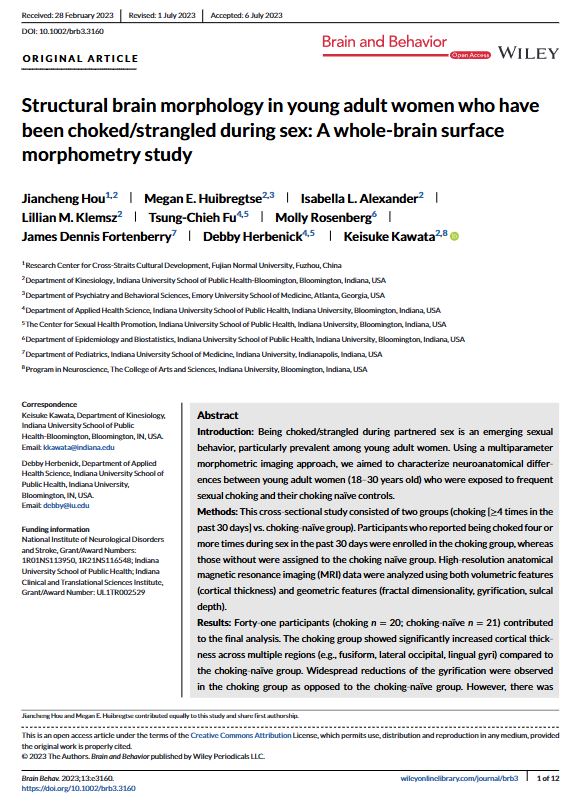
Structural brain morphology in young adult women who have been choked/strangled during sex: A whole-brain surface morphometry study.
Open Access: No.
Abstract
Introduction: Being choked/strangled during partnered sex is an emerging sexual behavior, particularly prevalent among young adult women. Using a multiparameter morphometric imaging approach, we aimed to characterize neuroanatomical differences between young adult women (18-30 years old) who were exposed to frequent sexual choking and their choking naïve controls.
Methods: This cross-sectional study consisted of two groups (choking [≥4 times in the past 30 days] vs. choking-naïve group). Participants who reported being choked four or more times during sex in the past 30 days were enrolled in the choking group, whereas those without were assigned to the choking naïve group. High-resolution anatomical magnetic resonance imaging (MRI) data were analyzed using both volumetric features (cortical thickness) and geometric features (fractal dimensionality, gyrification, sulcal depth).
Results: Forty-one participants (choking n = 20; choking-naïve n = 21) contributed to the final analysis. The choking group showed significantly increased cortical thickness across multiple regions (e.g., fusiform, lateral occipital, lingual gyri) compared to the choking-naïve group. Widespread reductions of the gyrification were observed in the choking group as opposed to the choking-naïve group. However, there was no group difference in sulcal depth. The fractal dimensionality showed bi-directional results, where the choking group exhibited increased dimensionality in areas including the postcentral gyrus, insula, and fusiform, whereas decreased dimensionality was observed in the bilateral superior frontal gyrus and pericalcarine cortex.
Conclusion: These data in cortical morphology suggest that sexual choking events may be associated with neuroanatomical alteration. A longitudinal study with multimodal assessment is needed to better understand the temporal ordering of sexual choking and neurological outcomes.
Relevance
“To our knowledge, this is the first study to examine the neuroanatomical characteristics in the brains of young adult women who experienced frequent, recent choking during partnered sexual activities” compared to young women who were not ‘choked’. There were three primary findings.
First, “the choking group had significantly increased cortical thickness in both hemispheres, including the frontal, temporal, parietal, and occipital lobes.”
“Second, the choking group showed increased cortical surface dimensionality in some regions (e.g., precentral gyrus, temporal gyrus) yet decreased dimensionality in many cortical regions.”
“Third, the choking group showed significantly reduced degrees of cortical folding (gyrification) in widespread regions.”
These data “provide the first evidence that frequently being choked/strangled during sex is associated with structural changes in the brain and could possibly alter cortical maturation in young adult women….It is important to acknowledge that choking during sex is the most common form of strangulation, and thus our findings have high public health significance.”
Citation
Hou, J., Huibregtse, M. E., Alexander, I. L., Klemsz, L. M., Fu, T. C., Rosenberg, M., Fortenberry, J. D., Herbenick, D., & Kawata, K. (2023). Structural brain morphology in young adult women who have been choked/strangled during sex: A whole-brain surface morphometry study. Brain and behavior, 13(8), e3160. https://doi.org/10.1002/brb3.3160