Legal Considerations

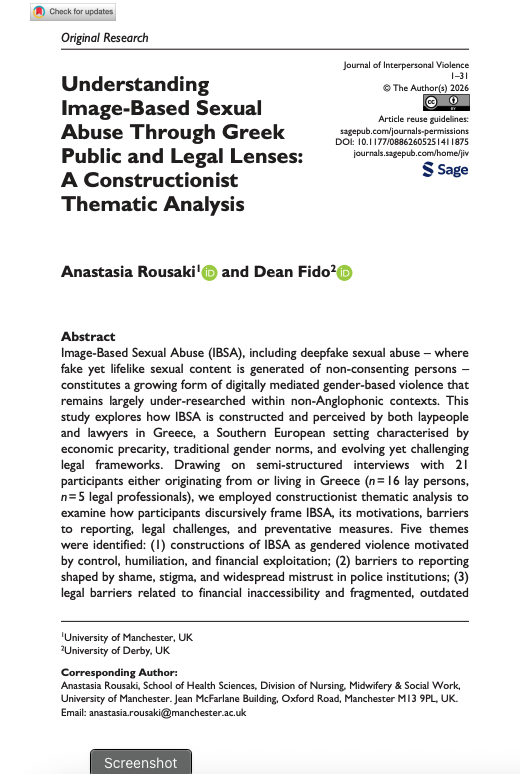
Understanding Image-Based Sexual Abuse Through Greek Public and Legal Lenses: A Constructionist Thematic Analysis.
Open Access: Yes.
Abstract
Image-Based Sexual Abuse (IBSA), including deepfake sexual abuse – where fake yet lifelike sexual content is generated of non-consenting persons – constitutes a growing form of digitally mediated gender-based violence that remains largely under-researched within non-Anglophonic contexts. This study explores how IBSA is constructed and perceived by both laypeople and lawyers in Greece, a Southern European setting characterised by economic precarity, traditional gender norms, and evolving yet challenging legal frameworks. Drawing on semi-structured interviews with 21 participants either originating from or living in Greece (n = 16 lay persons, n = 5 legal professionals), we employed constructionist thematic analysis to examine how participants discursively frame IBSA, its motivations, barriers to reporting, legal challenges, and preventative measures. Five themes were identified: (1) constructions of IBSA as gendered violence motivated by control, humiliation, and financial exploitation; (2) barriers to reporting shaped by shame, stigma, and widespread mistrust in police institutions; (3) legal barriers related to financial inaccessibility and fragmented, outdated legal frameworks; (4) the central role of informal support networks alongside calls for education and public awareness; and (5) deepfake technologies as an emergent form of economic exploitation, particularly impacting sex workers within a legal vacuum. The findings highlight the need for structurally informed, context-sensitive responses to IBSA that address the intersections of gender, law, technology, and economic vulnerability.
Relevance
Both Greek laypersons and legal professionals “framed women as the primary victims, reflecting enduring influences of patriarchal norms. While motivations for IBSA were linked to control and revenge, participants also identified financial gain as a driver.”
Participants revealed two impediments to reporting IBSA: “shame, stigma, and victim-blaming” and the perception of the police as “ineffective.”
Barriers to legal action included “limited access to justice, and how such access is shaped by class, with both laypeople and lawyers identifying financial constraints as a major barrier to reporting… Participants also criticised the inadequacy of current legislation, especially around deepfakes noting that legal frameworks have not kept pace with the evolving nature of tech-mediated abuse.”
For preventative measures and support, “participants highlighted the reliance on informal support networks in the absence of institutional support. Participants emphasised the role of family and friends in providing emotional and practical support, alongside calls for greater public awareness and digital literacy.”
Last, participants “voiced concern about the lack of legal protections for sex workers [more properly termed, ‘prostituted people’] and framed DSA [deepfake sexual abuse] as labour exploitation.”
Citation
Rousaki, A., & Fido, D. (2026). Understanding Image-Based Sexual Abuse Through Greek Public and Legal Lenses: A Constructionist Thematic Analysis. Journal of Interpersonal Violence. https://doi.org/10.1177/08862605251411875