Mental Health

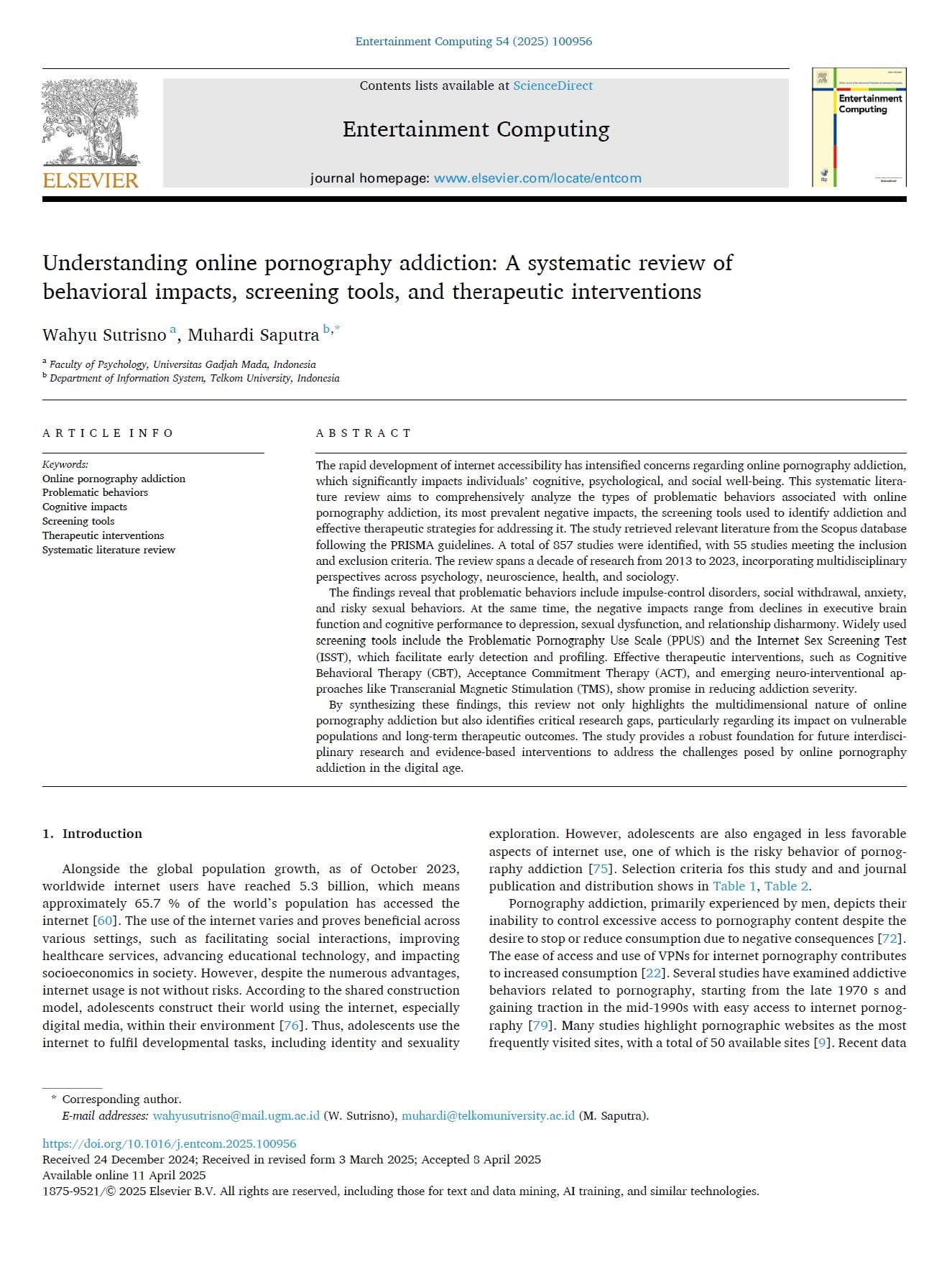
Understanding online pornography addiction: A systematic review of behavioral impacts, screening tools, and therapeutic interventions.
Open Access: No.
Abstract
The rapid development of internet accessibility has intensified concerns regarding online pornography addiction, which significantly impacts individuals’ cognitive, psychological, and social well-being. This systematic literature review aims to comprehensively analyze the types of problematic behaviors associated with online pornography addiction, its most prevalent negative impacts, the screening tools used to identify addiction and effective therapeutic strategies for addressing it. The study retrieved relevant literature from the Scopus database following the PRISMA guidelines. A total of 857 studies were identified, with 55 studies meeting the inclusion and exclusion criteria. The review spans a decade of research from 2013 to 2023, incorporating multidisciplinary perspectives across psychology, neuroscience, health, and sociology.
The findings reveal that problematic behaviors include impulse-control disorders, social withdrawal, anxiety, and risky sexual behaviors. At the same time, the negative impacts range from declines in executive brain function and cognitive performance to depression, sexual dysfunction, and relationship disharmony. Widely used screening tools include the Problematic Pornography Use Scale (PPUS) and the Internet Sex Screening Test (ISST), which facilitate early detection and profiling. Effective therapeutic interventions, such as Cognitive Behavioral Therapy (CBT), Acceptance Commitment Therapy (ACT), and emerging neuro-interventional approaches like Transcranial Magnetic Stimulation (TMS), show promise in reducing addiction severity.
By synthesizing these findings, this review not only highlights the multidimensional nature of online pornography addiction but also identifies critical research gaps, particularly regarding its impact on vulnerable populations and long-term therapeutic outcomes. The study provides a robust foundation for future interdisciplinary research and evidence-based interventions to address the challenges posed by online pornography addiction in the digital age.
Relevance
“Pornography addiction, primarily experienced by men, depicts their inability to control excessive access to pornography content despite the desire to stop or reduce consumption due to negative consequences.”
“One of the main impacts is a decrease in executive function in the brain, which can significantly affect cognitive abilities such as decision-making, rational thinking, concentration and memory.”
Other problematic behaviors associated with online pornography addiction include: lying and secrecy to hide pornography use, impulse-control disorders leading to compulsive usage, increased anxiety and depression, social withdrawal and isolation due to feelings of shame or maladaptive coping strategies, reduced sleep quality, impaired cognitive performance, risky sexual behaviors that increase susceptibility to sexually transmitted infections (STIs), executive brain dysfunction due to excessive dopamine release (which exacerbates emotional instability and mood swings), relationship disharmony, sexual dysfunction, and unrealistic sexual expectations.
“Chronic exposure to sexually explicit content may lead to neuroplastic changes that reinforce addictive behaviors, making it increasingly difficult for individuals to regulate their consumption patterns.”
Citation
Sutrisno, W., & Saputra, M. (2025). Understanding online pornography addiction: A systematic review of behavioral impacts, screening tools, and therapeutic interventions. Entertainment computing, 54, Article 100956. https://doi.org/10.1016/j.entcom.2025.100956.