
Inside the First Episode of The P-Word Podcast: Unpacking A Massive Social Experiment

From music videos to gaming to social media, pornographic images have become the blueprint for how women, men, boys, and girls are portrayed in our visual landscape. Young people are navigating a digital environment unlike anything previous generations have experienced. Pornography, social media, influencer culture, algorithms, and hypersexualized content are no longer separate conversations — they exist within the same ecosystem, shaping how young people understand sex, relationships, intimacy, and themselves.
This reality is what led Culture Reframed to launch its first-ever podcast, The P-Word Podcast: Beyond “The Talk.”
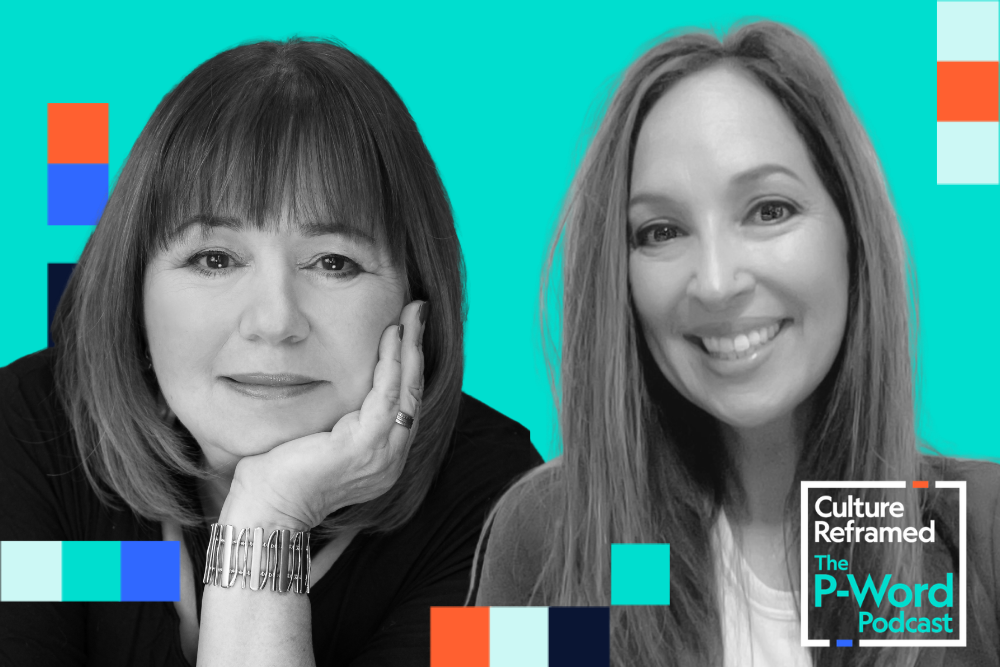
Hosted by Culture Reframed founder Dr. Gail Dines and Director of Programming Dr. Mandy Sanchez, the podcast brings together researchers, educators, advocates, and frontline professionals for research-based conversations about youth, media, and healthy development. Grounded in a public health framework, the series explores not only how hypersexualized digital culture affects young people, but also how parents, educators, and communities can respond without shame or blame.
In the first episode, Gail and Mandy reflect on why Culture Reframed was founded and its goal to build resilience and resistance to pornography in young people, the intersections of pornography and social media culture, and why conversations about youth well-being need to center the realities of the digital environment in which they are growing up.
Listen to the full episode here, and explore highlights below:
‘A Massive Social Experiment’
Early in the episode, Gail describes today’s digital landscape as an unprecedented social experiment unfolding in real time.
As she explains, young people now have immediate access to free, online, mainstream, hardcore pornography. This is no longer a hard copy of Playboy, but a vast, digital world of sexual cruelty, debasement, and dehumanization. All of this is accessible to any young person with an internet connection during one of the most formative stages of emotional, cognitive, and sexual development.
“I don’t remember signing any consent form to be part of this experiment,” Gail says, reflecting on the rapid normalization of violent online pornography and the documented impact of its long-term effects on young people and the ways it shapes their future adulthood.
Throughout the conversation, Gail and Mandy describe how platforms like TikTok, Instagram, Snapchat, Pornhub, and OnlyFans increasingly meld into one broader digital ecosystem in young people’s lives.
Mandy recalls speaking with middle school students about how trends and algorithms shape identity and self-perception. One sixth grader told her, “I don’t know what I like until I go to TikTok and see what’s popular and what’s trending.”
The concern, they explain, is not simply exposure to pornographic images, but that young people “should be allowed to develop their sense of self,” Gail says, “without the porn industry breathing down their neck.”
A Public Health Approach to Digital Culture
Throughout the episode, Gail and Mandy stress why Culture Reframed has uniquely adopted a public health framework that takes a broad, systemic approach to all forms of sexual violence. For too long, anti-violence groups have been siloed, but a public health approach brings all key players to the table.
The episode emphasizes that the organization’s work is not rooted in fear-based parenting or simply banning technology. Instead, Gail and Mandy focus heavily on helping young people develop critical thinking skills, emotional resilience, and media literacy within digital environments that are often engineered to capture attention and shape behavior.
Beyond ‘The Talk’
A major theme of the conversation is that discussions about pornography, consent, and digital culture cannot be reduced to one conversation between parents and children.
“The one big talk is outdated,” Mandy says, referring to the traditional idea that parents can prepare children for relationships, sexuality, and digital culture through a single conversation.
Instead, Gail and Mandy advocate for ongoing, developmentally-appropriate conversations that begin early and evolve over time. Throughout the episode, they discuss “scaffolding” conversations around consent, boundaries, media literacy, and relationships long before children encounter pornified content online.
“It’s never too late, never too early to start those conversations,” Mandy says.
Many adults and institutions remain deeply uncomfortable even saying the word “pornography,” despite how widespread and accessible it has become for young people.
“It’s the word that nobody can say, but everybody is seeing,” Mandy explains.
Why The P-Word?
That silence is part of what the podcast hopes to challenge. The P-Word Podcast is designed not only to help parents and professionals navigate difficult conversations but also to encourage broader public dialogue about the systems, industries, and digital environments shaping childhood and adolescence today.
As the first episode makes clear, Culture Reframed sees these conversations as extending beyond awareness alone. Alongside parenting guidance and digital media literacy, the podcast explores issues such as platform accountability, online youth protections, age verification laws, and collective action for healthier digital environments.
“You can’t live in a state of desperation,” Gail says during the conversation. “We have been charged with looking after the next generation.”
Never miss an episode! Subscribe to The P-Word Podcast on Spotify or Apple. Learn more about The P-Word Podcast here.