
Hot Topics: Understanding ‘Nudify’ Apps and the Deepfakes They Create

In this new series, “Hot Topics,” our team of researchers digs deep into the latest trends around pornography and the impact it’s having on young people. We break down what it is, how it works, why it’s trending, and what adults can do to minimize the harm to youth.
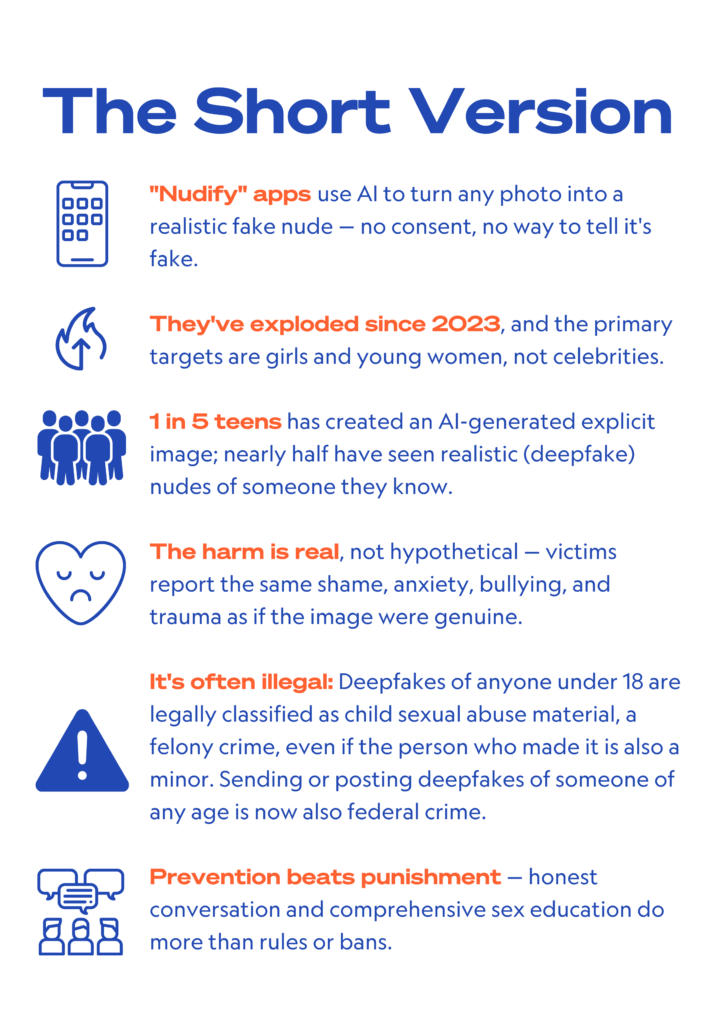
A few keystrokes. A single uploaded photo. Seconds later, a realistic — and entirely fake — nude image exists, and the person in it never consented, never knew, and often can’t prove it isn’t real. “Nudify” apps have moved from obscure coding forums to mainstream use in just a few years, and studies show that the people most affected by them are girls and young women, often in middle and high school.
Dr. Eric Silverman, a cultural anthropologist and Research Associate at Culture Reframed, breaks down how these tools work, why they’ve exploded in popularity, and what parents, educators, and other adults in young people’s lives can do, both to prevent harm and to respond if it’s already happened.

For people who haven’t heard of “nudify” or “undressing” apps, can you explain what these tools do and how they’ve become so accessible?
These are easy-to-use websites and apps that quickly make the people in a photograph appear realistically naked. There are hundreds of these programs online. All it takes is a few keystrokes to upload an image or photo — say, a high school student in her basketball uniform or prom outfit. Press a button and, after a few seconds, the same photo is returned, only this time the people depicted appear convincingly nude — without the victim ever having consented or even known. The image is so realistic that it is often impossible to tell that it was faked.
The computer programs or algorithms that generate these images are based on a type of Artificial Intelligence (AI) called “deep learning.” Hence, these fraudulent images are often called “deepfakes.”
The basic computer code for this type of application was developed around 2019. The code was then posted to a free online repository of computer programs (called GitHub, owned by Microsoft). Anybody with some technical skill in computer science or coding — even high school students using a typical gaming computer — could copy the program, make any modifications they wished, and create their own “undressed” images.
“Within a few years, hundreds if not thousands of people and porn-related companies churned out commercial and user-friendly versions that required no computer expertise.”
Within a few years, hundreds if not thousands of people and porn-related companies churned out commercial and user-friendly versions that required no computer expertise. Many of these apps are freely available to use or download on mobile phones, tablets, and computers running on Apple, Android, or Windows operating systems. They permit users — mainly men — to realistically undress any woman or girl they wish.
What’s driven this from a niche problem to an urgent one for young people?
Initially, the program was used by only a few people on certain online forums that tolerate violent pornography, racism, and misogyny, such as Reddit and 4chan. Because the program required some expertise in computer coding, it was a relatively specialized or niche endeavor — and mainly focused on undressing celebrities. It took a few years for these programs to catch widespread notice and, more importantly, for the computer code to be transformed into easy-to-use commercial and free versions. Then the apps exploded in popularity around 2023.
Once they did, the women and girls targeted were not just celebrities. The victims increasingly became ex-girlfriends, neighbors, peers, co-workers, and underage girls. And the latter, it is important to note, is legally classified as child sexual abuse material (CSAM).
Many of the commercial versions allow users to create a limited number of “nude” images without payment during a trial period. Some are entirely free as an enticement to the user to purchase other pornography-related software, such as “virtual girlfriends” (which are discussed in a Culture Reframed research report). Typically, undressing apps and websites also allow users to create non-pornographic, cartoonish images in the style of Japanese animation, or anime. So, in this sense, they merge harm with innocuous purposes.
Once undressing apps entered mainstream use, they moved beyond celebrities and politicians to target ordinary people. But “ordinary people” isn’t quite accurate — research shows these programs are almost always used by boys and men to undress women and girls. In fact, some commercial apps only work on photos of women and girls; they simply fail if the image shows a man. These tools were built to harass women, and it shows. It says something that the original computer code was trained exclusively on naked images of women.
That is a key point. Even nudifying apps that do work with images of boys and men are still largely aimed at undressing women and girls. You know this simply by looking at the examples provided by the apps. What these tools do in a pornified world is allow and encourage boys and men to transform any photo of any woman into pornography.
Commercial versions generally do not allow users to undress photos of obvious children. You typically can’t upload an image of a six-year-old. (If you have computer coding expertise, however, you can adjust the freely-available original computer code for these programs, and do so that way.) However, it is often visually unclear whether a teenage girl in a photo is 15 or 18. In this way, it is common for commercial versions to undress underage women, thus creating child sexual abuse material (CSAM). That ambiguity is why these apps are devastating many girls in middle and high school.
It is also important to note that I have never seen an undressing app during my research that requires the user to obtain consent from the person depicted in the photo. Nor have I seen one that also requires proof of age of the woman or girl depicted. This effectively teaches boys and men that it is their right to undress women and girls against their will and to have their naked images publicly displayed.
How are these tools reaching young people?
Young people know about these apps and websites from the media, their peers, advertising, and online forums. These tools are also widely advertised on social media, including LinkedIn, as well as on platforms especially common among young people, such as YouTube, Instagram, TikTok, and X (Twitter).
“It is important to realize that young people are digital natives. For them, online devices and digital technologies are seamlessly and ubiquitously woven into everyday life.”
It is important to realize that young people are digital natives. For them, online devices and digital technologies are seamlessly and ubiquitously woven into everyday life. They are growing up in a culture saturated with social media, online influencers, digital communication platforms, new technologies, AI, and online pornography. It is likely that many young people knew about undressing tools before most adults did.
Anything that happens online is almost, by definition, an integral part of young lives. Hence, it is probably true that very few young people today are unaware of these apps. This does not mean that all youth have used these tools to undress their peers. Nor does it mean that every young woman has been undressed to her horror. But every young person has surely discussed these tools with friends. They are part of the wider ebb and flow of their social lives.
According to a recent study, one in five teens has created pornographic images using readily available AI platforms and tools, including deepfakes of other people. One quarter of teens have shared deepfakes, and two-thirds fear becoming victims. Almost half of all teens have seen deepfake nudes, which commonly circulate on social media such as Snapchat, group messaging apps (e.g., WhatsApp), porn sites, and gaming platforms.
Some young men today trade these images, sometimes as tokens of their sexual experience or prowess. They are a way of jockeying for prestige within male peer groups. And once one of these images is sent to a few people in the local school or community, it catches like wildfire and goes viral.
What kind of harm does a young person experience when a fake image of them circulates? How are girls and boys experiencing this differently?
Let’s not think in terms of the crude, choppy Photoshop and cut-and-paste images of 10 years ago. Those were obviously fake. Today, undressing apps produce images that are utterly realistic and convincing. In terms of harm to women and girls’ reputations and the detrimental impact on their mental health, there is no difference between an actual nude image and a deepfake.
The harms reported by young people who have been targeted by deepfake nudes include everything we would expect had real naked images been circulated around the school and internet without their consent. They report humiliation, shame, ostracism, anger, and trauma. They fear for their personal and physical safety, especially when they are contacted and stalked by strangers who have seen the images and think that the person depicted is sexually promiscuous.
Victims — who are mainly women and girls — are harassed, mocked, and derided as “sluts” or “skanks.” They feel deeply violated and have trouble trusting others. They suffer anxiety, depression, panic attacks, social and family withdrawal, loss of concentration, and the inability to focus on schoolwork and other activities. They may become physically ill, uncontrollably sob, stop eating, or turn to drugs, alcohol, and self-harm to numb the pain. They typically loathe appearing in public or going to school, and may stop doing so altogether. Young victims, too, report suicidal ideation after the circulation of deepfake nudes. A few have died by suicide.
The emotional toll of deepfakes can be especially devastating for young people who are in some way vulnerable — say, struggling with mental health issues, past trauma, family instability, or grappling with a minority sexual and/or gender identity in a hostile climate. In some instances, a deepfake nude may be created as an intentional mockery of a person’s identity.
The reputational harm from deepfake nudes is often severe, and not just within a peer group or school. These images often reach parents, family members, coaches, teachers, employers, religious leaders, and others in supervisory roles. Most young people have not developed the resilience and psychological security or armor to fend off the harm from deepfake nudes. Nor have most adults, frankly.
Once an image circulates online, it is almost impossible to find and delete it. Hence, victims rightly fear that nude deepfakes could reappear at any time, even years later, and re-traumatize them. If a potential employer or university admissions officer sees the images, they would have no way of knowing that they are fake. Nor would a victim’s future children and coworkers. Images of a young woman appearing nude will be online forever. Indeed, the permanence of online images is what differentiates deepfakes from mere gossip in the pre-digital era.
“They are a form of sexual coercion.”
These images are often used to control a young person’s behavior, too. The threat of releasing deepfakes to parents, employers, teachers, and the public is enough to extort or ‘sextort’ something from the potential victim. Sometimes it is money; at other times it may be sex, which amounts to sexual assault or rape. Deepfakes are also used to keep girls and women within abusive relationships. They are a form of sexual coercion.
Because of the sexual double standard in our society, young men and women do not always experience deepfakes in the same way. Heterosexual boys may find them as a form of boasting. This almost never happens to girls, whose reputations continue largely to hinge on sexual modesty. A high school boy may turn a nonconsensual deepfake to his reputational advantage — as proof that he is a “player.” Young women generally find themselves tarnished as a “slut.”
How does this connect to the broader normalization of pornography that Culture Reframed focuses on?
Deepfake nudes are part of the same ecosystem as mainstream pornography. Undressing apps are widely advertised on the major free porn platforms that are visited by young people. They are often included in the lists posted to websites that review the “best” free porn sites. In the absence of the normalization of pornography, it is unlikely that deepfakes would have achieved the same level of popularity.
“In the absence of the normalization of pornography, it is unlikely that deepfakes would have achieved the same level of popularity.”
In fact, it is perhaps best to view these apps and websites as another arm of the pornography industry. Some porn platforms own undressing apps. Deepfakes promote the same sexist ideologies of women, female sexuality, female bodies, and male sexual entitlement that proliferate in mainstream pornography. Research, too, shows that young men who use porn are more likely to have seen, made, and circulated deepfakes of their peers and other women.
Boys and men who create deepfakes, like those who use pornography, tend to view women as objects. They typically subscribe to “rape myths” (that the victim “deserved” or “invited” it), harbor greater sexist opinions, and connect violence with sexuality. Research also shows that young people themselves often report that deepfakes promote the same false views as pornography as to what “normal” bodies look like. They say that deepfakes, like porn, push them to accept a distorted or “pornified” view of what authentic sex is supposed to be.
“Deepfakes, like porn, push them to accept a distorted or ‘pornified’ view of what authentic sex is supposed to be.”
Mostly boys and men view pornography; mostly boys and men create, distribute, and view deepfake nudes. Both forms of misogyny teach and reproduce the ideology that men have sexual dominance and ownership over women.
What actions are being taken to address this issue?
Many countries are now tackling deepfake pornography from a legal perspective. In April 2025, the U.S. Congress passed the Take It Down Act, which criminalizes the nonconsensual dissemination or posting of intimate images, including deepfakes. This law also requires online platforms — say, social media — to remove deepfakes upon request, as I discuss below. But laws are not enough to stem this dangerous tide.
Most schools now have policies about the spread of deepfakes and other forms of pornography. But these rules are often out of date, lukewarm, and vague. Too often, a “boys will be boys” attitude prevails, which diminishes the devastation to victims.
School policies and legislation inevitably fall short because both take effect after the fact: They are punitive rather than sufficiently preventive. What is needed is for schools, communities, legislators, and parents to demand that children are taught comprehensive, science-based, age-appropriate, relevant, and porn-critical sexual education in all grades, with no exceptions. Young people also need to be taught critical media literacy skills and online safety. As long as “sex” is treated as a taboo topic by parents and educators, not to be uttered or discussed, young people will turn to other sources for answers to their questions. And too often, they turn to pornography, a predatory industry which is happy to answer their questions with exploitation, misogyny, and the kinds of views and attitudes that lead to deepfakes.
“As long as ‘sex’ is treated as a taboo topic by parents and educators, not to be uttered or discussed, young people will turn to other sources for answers to their questions.”
A key part of a robust sexual education curriculum is honest conversation with youth about the pressures they experience today from a porn-saturated culture, and how they can build resilience while still respecting and enabling their honest, organic, and age-appropriate sexual development. In this way, the best way to curtail deepfakes is to teach young people a truly sex-positive — not pro-porn — view of human sexuality. By “sex positive,” I mean nothing more than an opportunity for each young person to experience their emerging sexual identity at their own pace, development, and level of comfort — to give them ownership over their own desires, and not let the wider porn industry, including deepfake technologies, steer that identity to its own purposes.
The only way to solve the problem of deepfake porn is to prevent it from happening in the first place — to teach children gender equality and gender respect from the earliest ages.
What should parents and caregivers do, both to get ahead of this and if they discover their child has been victimized or has victimized someone else?
There are a few practical steps that all parents and caregivers should take right now. First, it is crucial to talk to the young people in your charge about the harms of both deepfakes and pornography. Emphasize that they are one and the same. Be sure to talk in a way that is reassuring, non-confrontational, and that does not shame a child for developmentally appropriate interest in sexuality. It is crucial that adults talk to young people in ways that make them feel comfortable and confident in reaching out to discuss these issues. Culture Reframed has a compelling and science-based set of free educational materials to help guide these discussions. But beware: Simply telling children to not engage in these activities, or threatening to take away their devices, will only backfire. The research is clear on that point. They need ongoing, mutually respectful conversation that collaboratively sets limits and expectations.
“It is crucial that adults talk to young people in ways that make them feel comfortable and confident in reaching out to discuss these issues.”
Second, adults need to share in their children’s digital lives. Ask your kids to walk you through the AI and related apps and programs they use. Spend some time gaming with them. You want them to know that you have a genuine interest in their online lives — that you are not just setting limits and saying “no.” Explore with them their social media feeds, the websites they like to view, the sources of news and information they find compelling. This way, they will feel comfortable talking to you if and when they experience distressing digital and online encounters and events.
Third, urge your local schools and school boards to ensure they fully instruct kids on online harms as part of their wider commitment to health and wellbeing. Familiarize yourself with their relevant policies. Insist, along with other parents, that schools continuously develop policies about deepfakes and other online activities, and communicate honestly and regularly with students. Ask your school leaders to devote professional education days to the topic. Schools should work with local law enforcement, school resource officers, legislators, and — perhaps most importantly — mental health providers in and out of schools. Victims will need support. It is not difficult for school leaders to locate “best practices” for establishing and enforcing policies on deepfakes. Parents and caregivers have an obligation to ensure that they do so. And, to repeat, all this must occur within the wider context of honest sexual education — the kind that young people find relevant to their own lives.
Fourth, remind your kids that these apps, when applied to photos of anybody under the age of 18, create images that are legally defined as CSAM. It doesn’t matter that your 17-year-old son himself is a minor. If he creates deepfakes of his peers, he can be charged with a federal crime. Realistic but fake images of minors purportedly in the nude have the same legal status as real child abuse images or CSAM. They may be fake. But they are no less illegal. And even a quick Google search will show that boys today who create and circulate these images, even if they say they intended it as merely a joke, are being charged accordingly when caught. The consequences for a boy are not likely to be time in a federal prison. But they can and will be severe.
“Realistic but fake images of minors purportedly in the nude have the same legal status as real child abuse images or CSAM. They may be fake. But they are no less illegal.”
Note, too, that the parents of victims can file civil lawsuits that can include claims for sizable amounts of money as compensation for reputation harm, emotional distress, payment of mental health and other services. Even if authorities do not file charges, the victim and her family can still sue the offender’s parents for damages.
Fifth, if you live in the U.S., inform any children in your care of the new federal law mentioned above, which now makes deepfakes a serious matter, over and above the possibility of a CSAM charge. In fact, show your kids some recent news articles about the law and youth who have gotten into serious legal trouble for deepfakes. Have them read the new law — and do so yourself. Better yet, sit down with your kids and do all this together. (Note: Many other countries have similar laws.)
Sixth, familiarize yourself with the relevant state, local, and national laws. Consider asking your local school to host a parents’ event, recorded online for future viewing, in which school officials, local police, and the district attorney’s office all provide clear guidelines on what parents should do if they discover that their child has been victimized or is victimizing others. Different localities have distinct laws regarding, say, whether a parent should save the offending images, since they often constitute CSAM. It is important to know what to do about deepfakes before you might ever have to do it.
Seventh, if you do discover that your child has been victimized, you should file appropriate reports. In the U.S., for example, and in countries with comparable laws, online platforms — where deepfake images are likely to appear (e.g., social media) — are now legally required to have processes in place to report and take down deepfake images. If they do not, or if they refuse a request to remove them, you can and should file a complaint with the federal government. You can find further information via an easy-to-read information sheet from the Federal Trade Commission. There are also global agencies that can help victims identify and remove these images, as discussed on the same information page. Another excellent online resource that can guide victims and parents through these steps is “Report & Remove Intimate Images, Sexual Deepfakes, & Fake Nudes” by RAINN. Instances of deepfakes of minors should also be reported through a portal maintained by the Internet Watch Foundation and the International Centre for Missing & Exploited Children.
Last, if your child has been a victim of deepfakes, you should notify local law enforcement and school authorities. Do it in writing in addition to making a phone call. Even more important is to ensure that your traumatized child receives your unconditional support. No matter what they might have done, they did not deserve this harm. You should also carefully monitor your child’s mental and physical health, and most certainly seek out the advice of licensed mental health professionals, such as therapists, both for your child and for yourself. Do not go through this alone. Model for your child the importance of seeking professional assistance when needed. That is a sign of strength and resilience.
What’s one piece of advice you want every parent, teacher, and youth-serving adult to receive regarding this issue?
The single most important piece of advice is to engage young people now in respectful, honest, and open conversation about the harms of the entire pornographic ecosystem, which includes AI-generated or deepfake sexualized images. These harms will not stop simply by putting your foot down and sternly saying, “Don’t!” and crossing your fingers and hoping it doesn’t happen rarely works. These crimes and harassments will only be curbed through dialogue in which young people feel heard and validated. Avoid shaming and blaming. As Culture Reframed put it in one of our parental fact sheets, “Be the parent your child can feel both supported by and safe with.”