Grooming, Child Abuse, & Child Sexual Exploitation

Developmental experiences of child sexual abusers and rapists.
Open Access: No.
Abstract
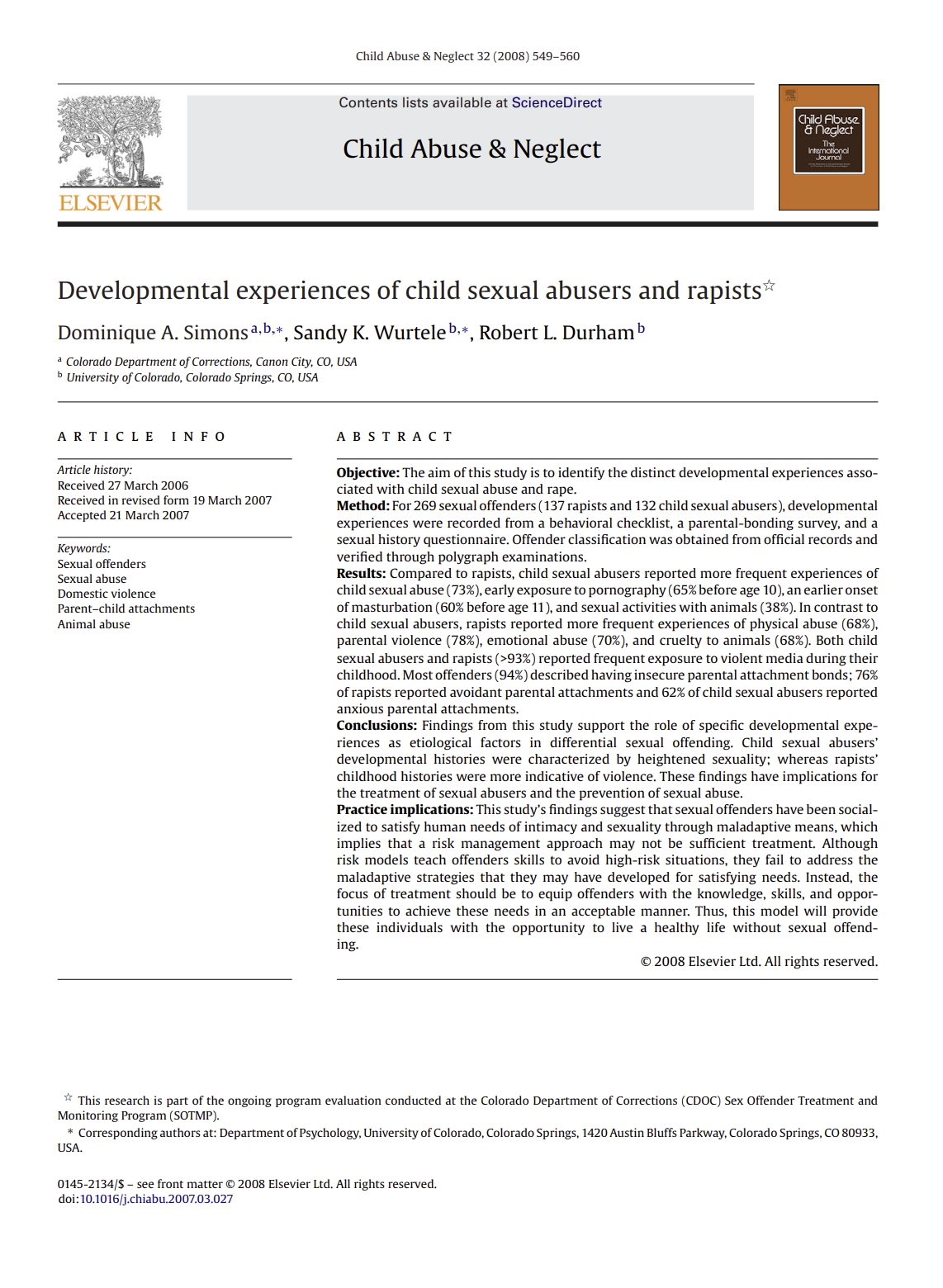
Objective: The aim of this study is to identify the distinct developmental experiences associated with child sexual abuse and rape.
Method: For 269 sexual offenders (137 rapists and 132 child sexual abusers), developmental experiences were recorded from a behavioral checklist, a parental-bonding survey, and a sexual history questionnaire. Offender classification was obtained from official records and verified through polygraph examinations.
Results: Compared to rapists, child sexual abusers reported more frequent experiences of child sexual abuse (73%), early exposure to pornography (65% before age 10), an earlier onset of masturbation (60% before age 11), and sexual activities with animals (38%). In contrast to child sexual abusers, rapists reported more frequent experiences of physical abuse (68%), parental violence (78%), emotional abuse (70%), and cruelty to animals (68%). Both child sexual abusers and rapists (>93%) reported frequent exposure to violent media during their childhood. Most offenders (94%) described having insecure parental attachment bonds; 76% of rapists reported avoidant parental attachments and 62% of child sexual abusers reported anxious parental attachments.
Conclusions: Findings from this study support the role of specific developmental experiences as etiological factors in differential sexual offending. Child sexual abusers’ developmental histories were characterized by heightened sexuality; whereas rapists’ childhood histories were more indicative of violence. These findings have implications for the treatment of sexual abusers and the prevention of sexual abuse.
Practice implications: This study’s findings suggest that sexual offenders have been socialized to satisfy human needs of intimacy and sexuality through maladaptive means, which implies that a risk management approach may not be sufficient treatment. Although risk models teach offenders skills to avoid high-risk situations, they fail to address the maladaptive strategies that they may have developed for satisfying needs. Instead, the focus of treatment should be to equip offenders with the knowledge, skills, and opportunities to achieve these needs in an acceptable manner. Thus, this model will provide these individuals with the opportunity to live a healthy life without sexual offending.
Relevance
“There is also support for a link between early exposure to graphic depictions of sexual interactions (i.e., pornography) and sexual offending. Men who commit sex crimes often report a history of early exposure to pornography; 86% of child sexual abusers described early exposure to pornography, as did 65% of rapists” as reported in an earlier study by the authors. “As the accessibility of hard-core pornography on the Internet continues to increase, the examination of early exposure to pornography as a risk factor for learning sexual offending behaviors has become even more imperative.”
“As compared to rapists, child sexual abusers reported significantly more frequent exposure to pornography before age 10; however, both child sexual abusers and rapists reported frequent early exposure to violent media.”
Citation
Simons, D. A., Wurtele, S. K., & Durham, R. L. (2008). Developmental experiences of child sexual abusers and rapists. Child Abuse & Neglect, 32(5), 549–560. https://doi.org/10.1016/j.chiabu.2007.03.027