Grooming, Child Abuse, & Child Sexual Exploitation

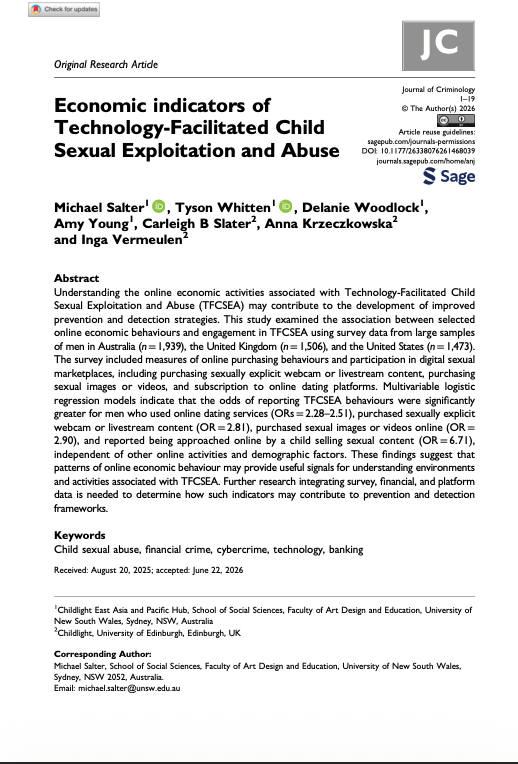
Economic indicators of Technology-Facilitated Child Sexual Exploitation and Abuse.
Open Access: Yes.
Abstract
Understanding the online economic activities associated with Technology-Facilitated Child Sexual Exploitation and Abuse (TFCSEA) may contribute to the development of improved prevention and detection strategies. This study examined the association between selected online economic behaviours and engagement in TFCSEA using survey data from large samples of men in Australia (n = 1,939), the United Kingdom (n = 1,506), and the United States (n = 1,473). The survey included measures of online purchasing behaviours and participation in digital sexual marketplaces, including purchasing sexually explicit webcam or livestream content, purchasing sexual images or videos, and subscription to online dating platforms. Multivariable logistic regression models indicate that the odds of reporting TFCSEA behaviours were significantly greater for men who used online dating services (ORs = 2.28–2.51), purchased sexually explicit webcam or livestream content (OR = 2.81), purchased sexual images or videos online (OR = 2.90), and reported being approached online by a child selling sexual content (OR = 6.71), independent of other online activities and demographic factors. These findings suggest that patterns of online economic behaviour may provide useful signals for understanding environments and activities associated with TFCSEA. Further research integrating survey, financial, and platform data is needed to determine how such indicators may contribute to prevention and detection frameworks.
Relevance
One in 12 men (8.4%) had perpetrated TFCSEA or Technology-Facilitated Child Sexual Exploitation and Abuse. More than a third (37.2%) had used online dating services; 13.1% had used cryptocurrency to make online purchases; 6.5% had purchased sexually explicit webcam or livestream services; 5.7% had purchased sexual subscription services, and 3.65 had purchased sexual images and videos from people online. “One in five (20.9%) men had ever been approached online by an adult selling sexual content or services, whereas one in fourteen (7.3%) had ever been approached online by a child” selling the same.
For the unadjusted associations, men who purchased sexually explicit images and videos from people online had an 18.5% greater probability of TFCSEA perpetration relative to men who had not purchased such content online. The next largest association was for being approached online by a child selling sexual content or services (OR = 12.96; AME = 17.2%), followed by having purchased sexually explicit webcams or livestreams (OR = 12.21; AME = 17.1%).
In the adjusted model, “being approached online by a child selling sexual content or services had the strongest effect size, corresponding to 6.71 times higher odds and 11.3% greater probability of TFCSEA perpetration. Significant associations were also observed for having purchased sexually explicit images and videos from people online (OR = 2.90; AME = 6.3%) and sexually explicit webcams or livestreams (OR = 2.86; AME = 6.2%). Online dating frequency was also significantly associated with TFCSEA perpetration.”
In all, three indicators were salient regarding TFCSEA perpetration: (i) being approached online by a child selling sexual content or services, (ii) purchasing sexually explicit content from people online (including webcams/livestreams), and (iii) use of dating/romance platforms.
Citation