Mental Health

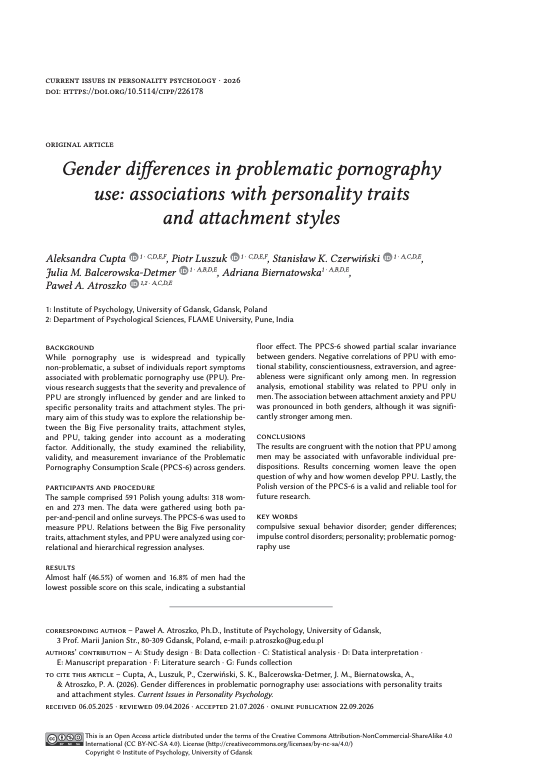
Gender differences in problematic pornography use: Associations with personality traits and attachment styles.
Open Access: Yes.
Abstract
Background:
While pornography use is widespread and typically non-problematic, a subset of individuals report symptoms associated with problematic pornography use (PPU). Previous research suggests that the severity and prevalence of PPU are strongly influenced by gender and are linked to specific personality traits and attachment styles. The primary aim of this study was to explore the relationship between the Big Five personality traits, attachment styles, and PPU, taking gender into account as a moderating factor. Additionally, the study examined the reliability, validity, and measurement invariance of the Problematic Pornography Consumption Scale (PPCS-6) across genders.
Participants and procedure:
The sample comprised 591 Polish young adults: 318 women and 273 men. The data were gathered using both paper-and-pencil and online surveys. The PPCS-6 was used to measure PPU. Relations between the Big Five personality traits, attachment styles, and PPU were analyzed using correlational and hierarchical regression analyses.
Results:
Almost half (46.5%) of women and 16.8% of men had the lowest possible score on this scale, indicating a substantial floor effect. The PPCS-6 showed partial scalar invariance between genders. Negative correlations of PPU with emotional stability, conscientiousness, extraversion, and agreeableness were significant only among men. In regression analysis, emotional stability was related to PPU only in men. The association between attachment anxiety and PPU was pronounced in both genders, although it was significantly stronger among men.
Conclusions:
The results are congruent with the notion that PPU among men may be associated with unfavorable individual predispositions. Results concerning women leave the open question of why and how women develop PPU. Lastly, the Polish version of the PPCS-6 is a valid and reliable tool for future research.
Relevance
The study found that 1.6% (n = 5) of women and 14.3% (n = 39) of men met the criteria for PPU [problematic pornography use].
“PPU among men was inversely correlated with emotional stability, agreeableness, and conscientiousness”; these associations “were not statistically significant among women.”
“Higher neuroticism (i.e., lower emotional stability) and lower conscientiousness showed the strongest associations with PPU.”
“Contrary to expectations, PPU in women was unrelated to any of the personality traits from the Big Five model.”
“Attachment anxiety was positively related to PPU in both genders.”
In conclusion, “The findings suggest stronger and more consistent associations between PPU, personality traits, and attachment anxiety among men, whereas the findings among women were less. clear and should be examined further.”
Citation
Cupta, A., Luszuk, P., Czerwiński, S. K., Balcerowska-Detmer, J. M., Biernatowska, A. & Atroszko, P. A. (2026). Gender differences in problematic pornography use: Associations with personality traits and attachment styles. Current Issues in Personality Psychology. https://doi.org/10.5114/cipp/226178