Mental Health

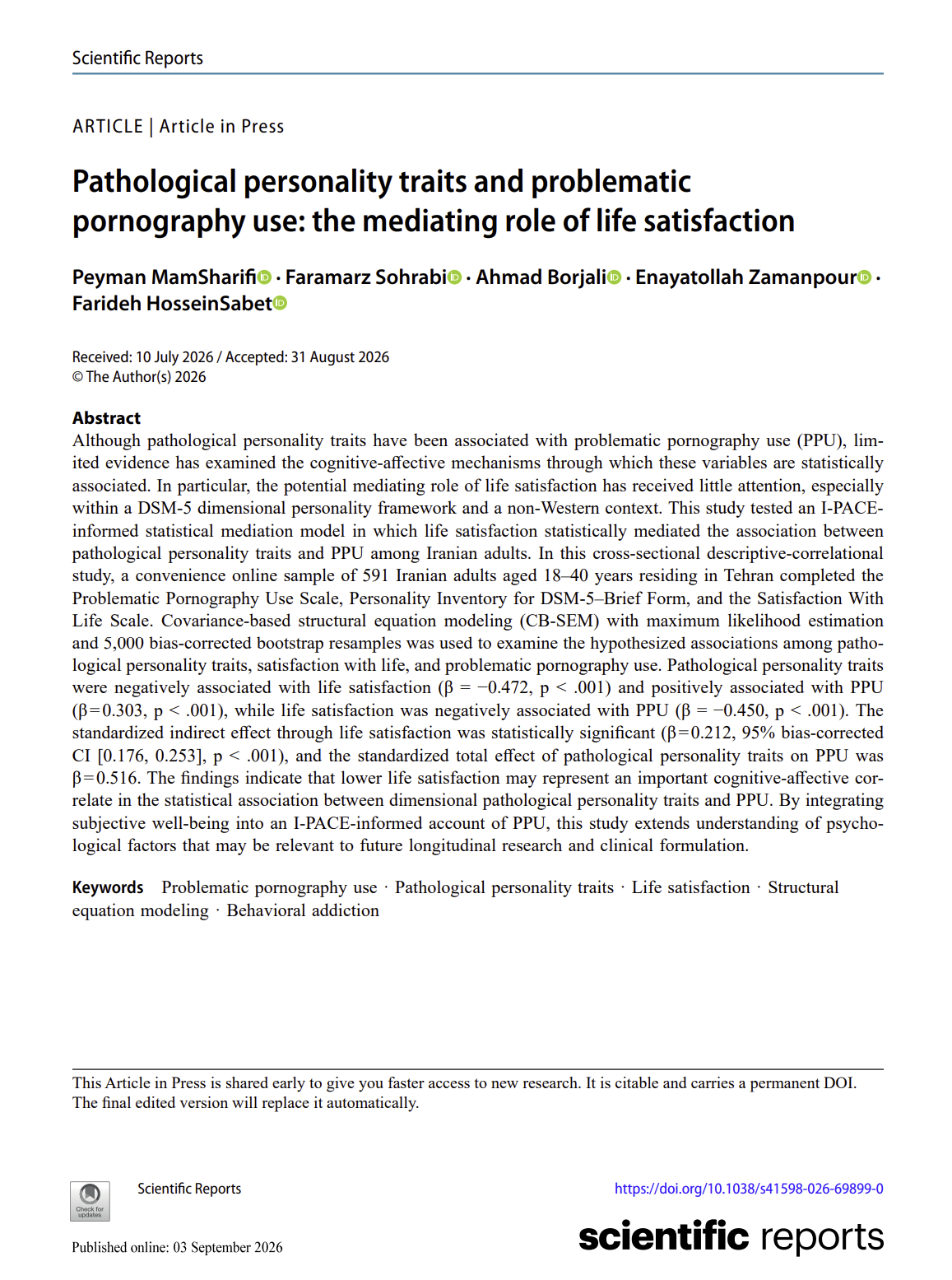
Pathological personality traits and problematic pornography use: The mediating role of life satisfaction.
Open Access: Yes.
Abstract
Although pathological personality traits have been associated with problematic pornography use (PPU), limited evidence has examined the cognitive-affective mechanisms through which these variables are statistically
associated. In particular, the potential mediating role of life satisfaction has received little attention, especially within a DSM-5 dimensional personality framework and a non-Western context. This study tested an I-PACE informed statistical mediation model in which life satisfaction statistically mediated the association between pathological personality traits and PPU among Iranian adults. In this cross-sectional descriptive-correlational study, a convenience online sample of 591 Iranian adults aged 18–40 years residing in Tehran completed the Problematic Pornography Use Scale, Personality Inventory for DSM-5–Brief Form, and the Satisfaction With Life Scale. Covariance-based structural equation modeling (CB-SEM) with maximum likelihood estimation and 5,000 bias-corrected bootstrap resamples was used to examine the hypothesized associations among pathological personality traits, satisfaction with life, and problematic pornography use. Pathological personality traits were negatively associated with life satisfaction (β = −0.472, p < .001) and positively associated with PPU (β=0.303, p < .001), while life satisfaction was negatively associated with PPU (β = −0.450, p < .001). The standardized indirect effect through life satisfaction was statistically significant (β=0.212, 95% bias-corrected CI [0.176, 0.253], p < .001), and the standardized total effect of pathological personality traits on PPU was β=0.516. The findings indicate that lower life satisfaction may represent an important cognitive-affective correlate in the statistical association between dimensional pathological personality traits and PPU. By integrating subjective well-being into an I-PACE-informed account of PPU, this study extends understanding of psychological factors that may be relevant to future longitudinal research and clinical formulation.
Relevance
“The current study evaluated an I-PACE-informed model examining life satisfaction as a mediator in the relationship between pathological personality traits and PPU within an Iranian sample. The findings were consistent with all four hypotheses. Pathological personality traits were negatively associated with life satisfaction (H1) and positively associated with [problematic phonography use] PPU (H3). Furthermore, life satisfaction was negatively associated with PPU (H2) and statistically mediated the relationship between pathological personality traits and PPU (H4). These results suggest that individuals with higher dimensional elevations in pathological traits report lower life satisfaction and that lower life satisfaction is statistically associated with greater severity of problematic pornography use. This pattern is consistent with previous research linking maladaptive personality characteristics to poorer psychological adjustment and lower life satisfaction16 and with research suggesting that PPU may be associated with maladaptive coping and emotion-regulation processes.”
Citation
MamSharifi, P., Sohrabi, F., Borjali, A., Zamanpour, E., & HosseinSabet, F. (2026). Pathological personality traits and problematic pornography use: The mediating role of life satisfaction. Scientific Reports. https://doi.org/10.1038/s41598-026-69899-0