Socialization & Relationship Outcomes

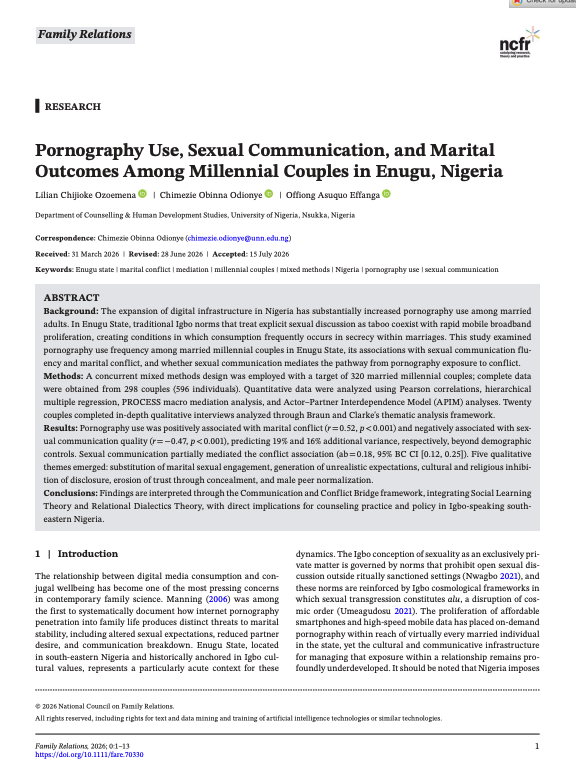
Pornography Use, Sexual Communication, and Marital Outcomes Among Millennial Couples in Enugu, Nigeria.
Open Access: Yes.
Abstract
Background
The expansion of digital infrastructure in Nigeria has substantially increased pornography use among married adults. In Enugu State, traditional Igbo norms that treat explicit sexual discussion as taboo coexist with rapid mobile broadband proliferation, creating conditions in which consumption frequently occurs in secrecy within marriages. This study examined pornography use frequency among married millennial couples in Enugu State, its associations with sexual communication fluency and marital conflict, and whether sexual communication mediates the pathway from pornography exposure to conflict.
Methods
A concurrent mixed methods design was employed with a target of 320 married millennial couples; complete data were obtained from 298 couples (596 individuals). Quantitative data were analyzed using Pearson correlations, hierarchical multiple regression, PROCESS macro mediation analysis, and Actor–Partner Interdependence Model (APIM) analyses. Twenty couples completed in-depth qualitative interviews analyzed through Braun and Clarke’s thematic analysis framework.
Results
Pornography use was positively associated with marital conflict (r = 0.52, p < 0.001) and negatively associated with sexual communication quality (r = −0.47, p < 0.001), predicting 19% and 16% additional variance, respectively, beyond demographic controls. Sexual communication partially mediated the conflict association (ab = 0.18, 95% BC CI [0.12, 0.25]). Five qualitative themes emerged: substitution of marital sexual engagement, generation of unrealistic expectations, cultural and religious inhibition of disclosure, erosion of trust through concealment, and male peer normalization.
Conclusions
Findings are interpreted through the Communication and Conflict Bridge framework, integrating Social Learning Theory and Relational Dialectics Theory, with direct implications for counseling practice and policy in Igbo-speaking south-eastern Nigeria.
Relevance
Participants described pornography as: progressively displacing sexual communication with their partners; generating unrealistic and comparative evaluations of partners’ bodies and sexual performance; and creating marital tension through the erosion of trust and emotional intimacy; and the reproduction and male norms. Participants also noted that religious and cultural norms were a barrier to addressing the use of pornography directly.
“Significant positive associations were found between pornography use and marital conflict, and significant negative associations between pornography use and sexual communication quality.”
Citation
Ozoemena, L. C., Odionye, C. O., & Effanga, O. A. (2026). Pornography Use, Sexual Communication, and Marital Outcomes Among Millennial Couples in Enugu, Nigeria. Family Relations. https://doi.org/10.1111/fare.70330