
The P-Word Podcast: What OnlyFans Is Really Teaching Young People

A struggling young mom turns to OnlyFans to pay her bills on Apple TV’s Margot’s Got Money Troubles. Sydney Sweeney’s character does the same on HBO’s Euphoria. Even Abbott Elementary has joked about it. What was once a niche platform has become a recurring plot device — a shorthand that pop culture now reaches for without a second thought.
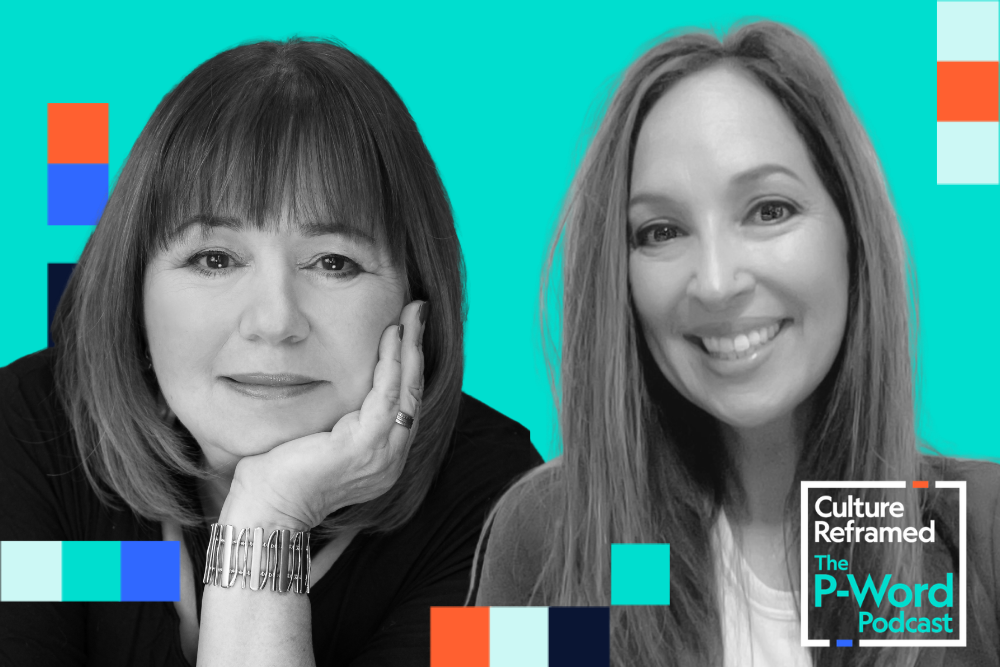
That shift is the starting point for the second episode of The P-Word Podcast: Beyond “The Talk,” hosted by Culture Reframed founder Dr. Gail Dines and Director of Programming Dr. Mandy Sanchez. In this episode, Gail and Mandy trace how OnlyFans moved from the margins to the mainstream, and what it means that hypersexualized content-creator platforms, reality TV, and algorithm-driven social media are no longer background noise in young people’s lives but part of the entertainment they consume every day.
Watch or listen to the full episode here, and explore highlights below:
How OnlyFans Became Pop Culture
Kids don’t need to seek out OnlyFans to absorb its logic. It’s already embedded in the shows they watch every day. Mandy describes visiting schools where children as young as 9 or 10 were fluent in Love Island, Peacock’s dating competition now in its eighth season, and in terms like “looksmaxxing” and “pornmaxxing”: optimizing appearance and sexual performance to porn-industry standards. Middle schoolers, she recalls, casually referenced extreme practices like “bone smashing” for a more chiseled jawline, while their teachers looked on in horror.
Love Island gamifies this explicitly. Contestants are ranked, and in one recurring segment, biometric monitors track men’s arousal as women perform for the group. It’s a competition show about romance that functions, Gail and Mandy argue, as a socially acceptable delivery system for porn scripts — behavior that would read as shocking outside the show becomes entertainment inside it. OnlyFans, in other words, doesn’t exist in isolation. The surrounding culture has already primed young audiences to see this as normal, aspirational, even fun.
What OnlyFans Actually Is
OnlyFans grew out of sex camming, in which viewers pay to watch and direct a performer in real time, a business model Gail says the platform brought into the mainstream over the past five or six years. The growth has been staggering: Subscriber numbers climbing from roughly 13.5 million in 2019 to over 300 million today, with the number of creators — mostly women and girls — rising from 1.6 million in 2020 to 4.6 million now.
The business model underneath that growth is built for extraction. OnlyFans takes a cut of creators’ earnings and incentivizes existing creators to recruit others by offering a percentage of their referrals’ earnings, a structure Gail compares to a pyramid scheme. Meanwhile, the platform employs only a small moderation staff relative to its size, making meaningful content oversight nearly impossible. Many creators build a following on Instagram or TikTok first, then funnel that audience to OnlyFans.
The Bop House, Social Media, and the Pipeline to OnlyFans
The Bop House makes that pipeline concrete: a group of teen girls who built massive followings — collectively around 90 million — on Instagram and TikTok before moving into a shared house in Florida, where they livestream a lifestyle of houses, cars, and private jets funded by OnlyFans content. Some wait until they turn 18 to open an account; others don’t. Either way, the setup functions as advertising, showing younger followers that this path is glamorous, easy, and safe.
What makes that message so persuasive, Mandy argues, is the absence of any competing one. Kids see influencers, reality shows, and their own peers present platforms like OnlyFans as an appealing, low-effort way to make money, while schools and families rarely offer a real alternative narrative. Without critical media literacy or comprehensive sex education filling that gap, the “easy” path is often the only one being sold at all.
Consent, Coercion, and ‘the Male Gaze on Steroids’
What looks like choice, Gail argues, is often something closer to stealth coercion. Adolescence is a stage defined by the need to fit in, and peer approval can outweigh even parental influence — in that context, “choice” looks less like free will and more like the path of least resistance.
That shows up directly in what Mandy hears from students. Despite decades of consent education, many teens, especially girls, arrive at basic gaps: not knowing they’re allowed to say no, that consent can’t be given while asleep or intoxicated, or that they’re allowed to change their mind mid-encounter. Boys, meanwhile, are often socialized not to expect or accept a “no” in the first place. It’s this dynamic, pervasive now across entertainment and social media, that Mandy sums up bluntly: “We’re talking about the male gaze on steroids.”
What Helps — Porn-Critical Sex Ed
The response Culture Reframed offers is a free porn-critical sex education curriculum, developed with UK educators roughly two and a half years ago. The 16-week program is built around an anti-exploitation framework, starting by helping young people understand exploitation on a broader, structural level before moving into more traditional relationship and sex-ed content.
It also trains teachers, many of whom are asked to teach sex ed with little preparation, both in the subject matter and in how to deliver it with confidence. Standalone digital media literacy lessons are built in, and the whole curriculum is customizable to a given school community. It’s already in use by teachers, after-school programs, and child advocacy centers worldwide.
Policy — Age Verification and Accountability
Education alone isn’t enough, Gail argues. It has to be paired with real regulation. The UK’s age-verification law is her example of legislation with actual teeth: sites found non-compliant face fines of roughly £10 million (about $13–14 million) or 10% of their profits, whichever is higher. Since the law took effect, traffic to Pornhub in the UK has dropped by roughly 70%, and the site has reportedly considered pulling out of the market entirely.
The law isn’t foolproof — some teens will use VPNs to get around it — but many porn sites are now blocking VPN access themselves, wary of running afoul of the law. Gail also dismisses the industry’s usual privacy objections, arguing that porn platforms already collect and sell user data at scale. For her, the UK’s approach shows what accountability looks like when lawmakers are willing to enforce it.
Never miss an episode! Subscribe to The P-Word Podcast on Spotify or Apple. Learn more about The P-Word Podcast here.